
Location Codex Entry
Earth
Eight sapient species. One world. 97,000 years of transformation.
All Eras · 50,000 BC – 47,200 AD"Other worlds build empires. Earth builds species. The difference is theological."
— Elder Archivist Kel'voran, on Human Persistence
The Essential
In 4280 AD, the survivors of humanity's near-extinction—the 0.1% who weathered the Great Cataclysms—looked at their devastated biosphere and made a decision that would reshape galactic civilization: they uplifted six species to full sentience. Canines, Felines, Primates, Swine, Cephalopods, and Cetaceans were engineered into co-equal citizens of a world that no longer belonged to humans alone. No other species in recorded history has voluntarily shared its homeworld this way.
Today, Earth functions as the administrative capital of the Lumen Coalition of United Systems—a political entity spanning 6,000 star systems, 39,000 planets, and all nine known galaxies. The irony is not lost on historians: the cradle of humanity's apocalypse became the throne room of interstellar governance.
Earth did not survive its cataclysms. It graduated from them—rewriting its own atmosphere, its species roster, and its definition of what "civilization" could mean.
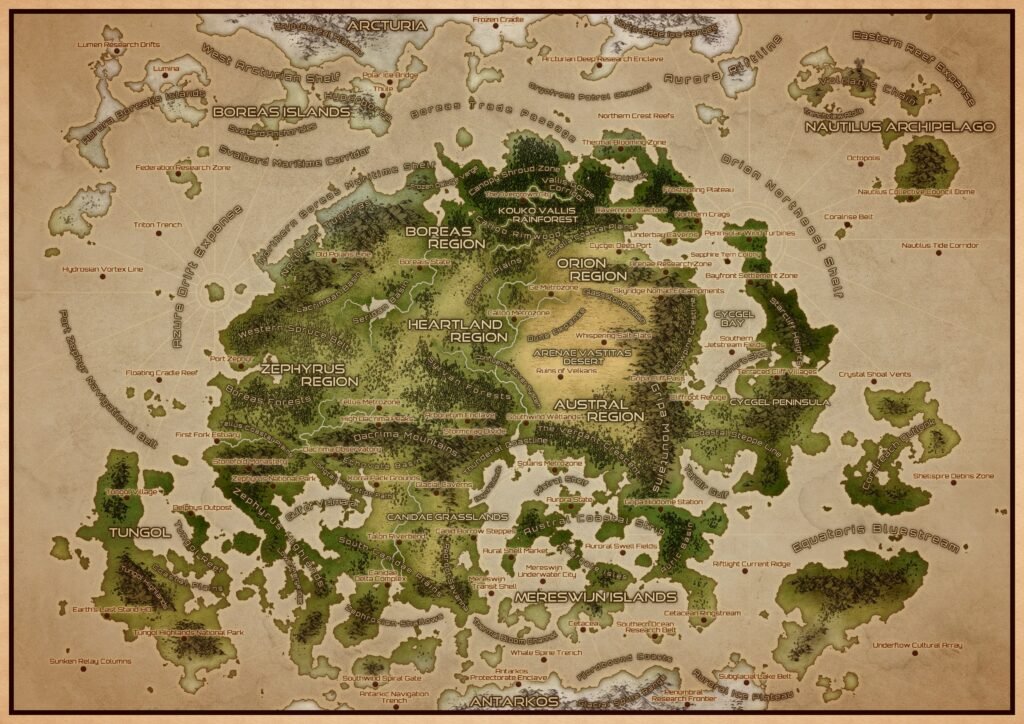
The planet's geography tells the story. Where seven continents once drifted, a single supercontinent now dominates: UniTerra, formed when tectonic upheaval fused landmasses during the 28th century. The atmosphere itself carries the signature of catastrophe—oxygen levels stabilized at 27-29%, a permanent reminder of the biosphere's violent rebirth. Five distinct regions now host the eight sapient species, each governed through the Earth Council, where every species holds equal voice regardless of population.
The Lumens—transcendent post-humans who emerged from the Chrono-Biogenesis Project in 7800 AD—number only 100,000 on their homeworld. Yet they administer an empire of trillions. The Canines, at 4 billion, dominate the population charts. The original humans, now called Holdouts, persist at 500 million—a fraction of the 8 billion who once claimed sole dominion.
Planetary Data
In the Stories
The Last Run to Tungol is set during the Surf and Turf Wars (6324-6689 AD), when the Cetaceans weaponized climate itself against baseline humanity. Captain Iriya smuggles seeds through a naval blockade to the last major human holdout—while hiding mutations that mark her as something the purists would execute. The story captures Earth at its most fractured: eight species, one planet, and the question of what "human" even means anymore.
Access Full Archive
Explore on World Anvil →Related Entries
Story File
Read: The Last Run to Tungol (Coming Soon) →