

A valley of rolling hills, warm air, sweet water, and grey peaks that end the world. Food rises from the soil on schedule. Every detail confirms that existence is gentle. None of it is natural — it is an isolation pen inside SED-1, printed terrain under a holographic sky, its flora wired to read the mind of the single occupant it was built to keep stable.
Aristotle walks to the edge of that world, embraces the wall he mistakes for a mountain, and gives thanks in words he did not choose and cannot get rid of. Then he hears footsteps that are not his own. Eleven floors above, a technician on the night shift sees two lights where there should be one, and files it as a calibration fault.
The End of the World
Aristotle reached the end of the world on his walk today. He usually tries to reach the end of the world before the hot brightness in the sky retreats below the mountains, with the goal of getting to the other side of the world the following day. To do so feels natural, as if his existence is conditional upon such activity. Doing so suppresses the cloying sensation that the thoughts in his head are not his own.
Aristotle reached the end of the world. The tall grey peaks erupt from the ground vertically, totally impassable. He cannot look past them; there is nothing past them. He walks right up to the world's walls and rubs his large white tusks against their face. This is good.
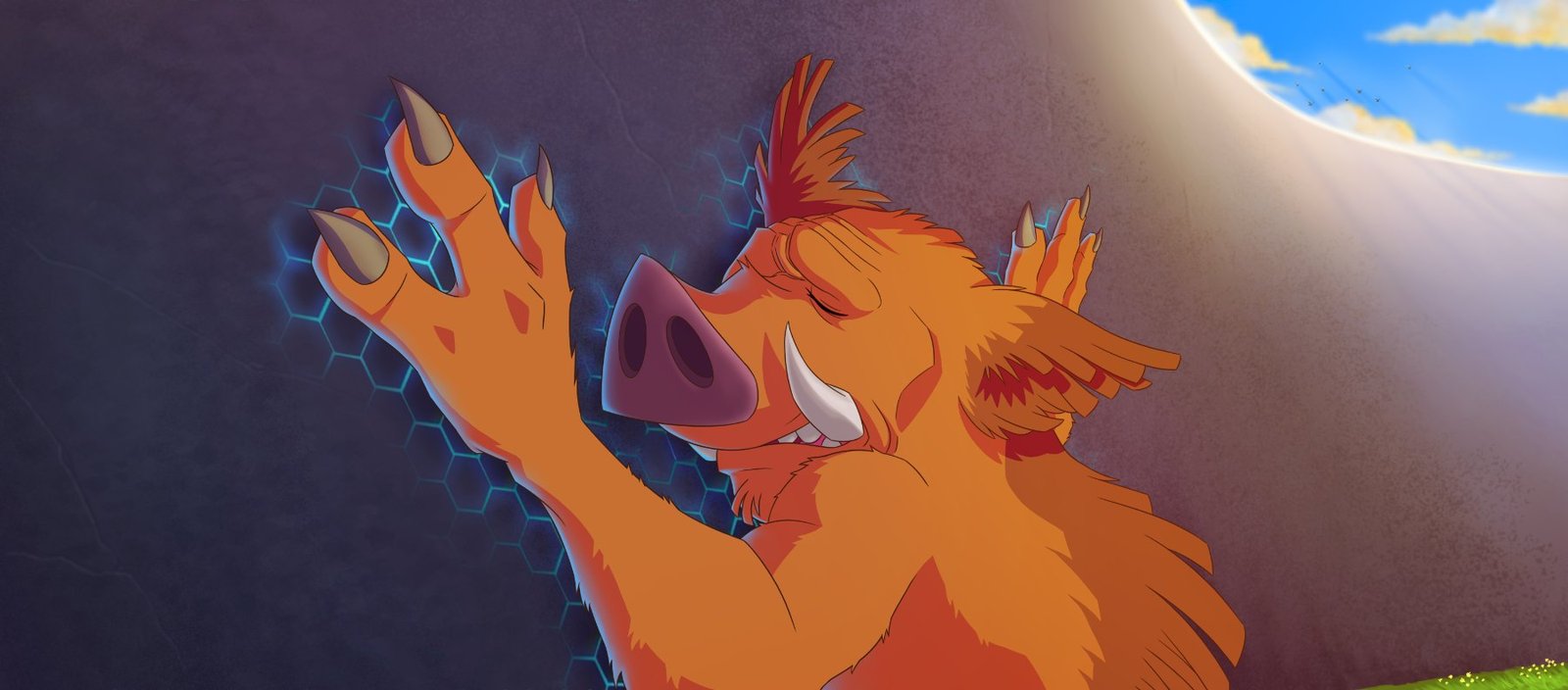
His ablutions are interrupted by the formation of a scent. Not quite wanting to be interrupted yet, Aristotle outstretches his large hairy arms and embraces the rocky wall of the world. A tear forms in his eye as he gives thanks to the world — a tear of joy for the world's beauty, a tear of sadness because he must say thanks using words that are not his own. Soon the scent coming up from the ground becomes unignorable. His form feels empty. He needs to feed.
Aristotle stops embracing the wall and squats down towards the ground. He pauses before drawing a single long inhale through his nostrils. Every time he does so it creates a war in his mind, and this time is no different. All his words desperately try to withstand the onslaught of information that his nostrils can bring forth. No matter how many times he breathes in, the words remain. His feet are rooted to the ground as he smells the food coming up from the Earth getting ever closer. He goes down onto his hands and knees and sticks his nose into the ground and breathes once more. The food is coming. Hasty for its arrival, Aristotle uses his tusks and snout to begin rooting into the ground, to access that which gives him life. A clot of soil gets stuck in one of his nostrils, causing him to sneeze it out. Using his fingers to clean himself he pauses, crouching to the ground. The food is as close as it usually gets; it is now up to him to reach it. The soil in his snout was unpleasant, and without giving it much thought Aristotle begins to use his hands to dig in the soil. Moving around pebbles and inedible roots, his pace increases as the tantalizing odor beckons. He notes to himself that digging with his hands frees up his nose to smell, allowing him to work more efficiently. Reaching the cache of plump tubers he pulls them from the ground and stacks them into a small pile. Once all of the tubers in the world were removed from the ground he begins eating them, while holding in his heart the hope and the prayer that the next day's harvest will rise from the soil as all others have before it.
Leaning his head against the wall of the world, Aristotle drifts off to sleep while he wonders and gives thanks. Thanks for the soil that gives him food. Thanks to the world for being so kind and gentle to him. The stone wall of the world is cool to the touch, which relaxes and coaxes him into the oblivion of sleep that must be different from the death that he finds a way to fear without yet understanding.
When in sleep he dreams. One day he will be embarrassed by this.
Night Shift
Pira did not enjoy working the night shift. She somehow managed to slide from the computer monitor station towards the table with the assorted sweet carbohydrates, grab one of the treats on the table, stuff half of it in her mouth, and slide back to the monitor before realizing that she grabbed the nut cake. She realized her error just as she returned to her post. As all of the monitors and indicators measuring the status of the enclosure pens continued to happily blink their green of "all-clear," Pira's taste buds flagged that there definitely was a problem. Not having the time to grab anything to catch it, Pira retches onto the table in front of the monitor interface. It is only after the cake lands onto the table that the unmistakable nutty odor reaches her nose. She gets up from her table and stares at the rejected cake. Marginally chewed and sticky with saliva, the pile of spongy dessert seems to dissolve, its delicate structure unable to withstand the might of Pira's lingual lipase and amylase. Pira disposes of the cake.
Embarrassed by this brief lapse in her usually dignified comportment, Pira's glance briefly slides from her monitor interface to the camera directed at her. All of its lights are extinguished. The escape of the canines twenty-seven years ago has made Dacrima rightfully paranoid. Having the work of Project Ascendancy — the current apex of human ingenuity and capacity — mostly undone by an errant meteorological phenomenon rattled humanity, from all the way up to those who tell Pira what to do, down to those that Pira looks at with pity. Of course, constant surveillance on its workers proved to be an ethical sore spot. Her superiors and various ethics overseers touted that the cameras they will be installing in the facility were cutting-edge "retroactive videographic systems." That, at least in theory, only will have found itself to have started recording in the event of a catastrophe that already happened. Pira remembers the meetings where all of the presenters were cracking jokes about the difficulty in finding the right verb tense to describe what the cameras did. In unofficial communication channels the current operating theory is that the technology is totally bunk and basically equated to time travel. While Pira certainly did not want one of her nameless coworkers to witness her little accident with the nut cake, she did not in theory have a problem with somebody watching over her while she did her work. It could make these night shifts less lonely.
It was proving to be a boring and long night. All of the parameter indicators in the pens were reading out numbers that were aggressively normal. Everyone has already gotten fed. When Pira first started working at SED-1 she viewed the cutting-edge tech of the pens with an almost religiously informed awe. However, the months of tedium and the fact that nothing interesting had really happened has worn down this awe and replaced it with the more mundane feeling of being acutely aware of her own insignificance. She is not appreciating something wondrous and beautiful; she herself is an ant.
The constructed nature of the sus sapiens environment was an attempt to remove the variables that allowed for the fiasco with the canines. Using a combination of biologic-printing and 3-D holographic projections, SED-1 has created more than half a dozen little worlds for the sus sapiens. When the ethics supervisors were not trying to quash the unease of the lower-level employees about the video surveillance, they were engaged in work that was more originally part of their job description: the unanswerable questions about how to direct the development of a new conscious species. This intersection between the ethicists' queries and the technologists' new toys created a bit of an inter-departmental arms race.
Supra-Bucolic
The ethicists were absolutely adamant that in order to properly steer the development of this new uplifted species (that they are going to do correctly, mind you!) they would need a list of technological integrations into the pens that got increasingly outlandish. It started with total physical mastery within the space, granular contouring of the rolling hills and jagged boundary peaks. Then it got more abstract — direct pheromonal integration with all flora, and direct neural surveillance into all of the sus to allow real-time feedback and construction, so all of the intangible features of a "natural" environment — its wind, odor, color, and the rest — were intentionally mirrored to each of the subject's psychosphere. It was supra-bucolic. Another common joke in the informal comms is to say that each of the employees should get one of the pens as a retirement gift. A personal, private eden.
All of this is now several months old; everything has been operating smoothly. The sus are healthy, happy, and docile. The so-far flawless execution of this latest uplift has allowed the higher-ups to shower themselves with praise and congratulation. After getting bored with commending themselves, they eventually found the time to acknowledge the contributions of people at Pira's level. At current trends of success, the lowest-level employees are only several short months out from being congratulated.
The inertia of operation has turned what was once exciting and new into the new normal. The sus continue walking around their pens, and the ethicists and technologists proceed with the extreme caution of those who have the world to lose.
Unbeknownst to Pira, this very day held a high-level negotiation between the two competing factions within SED-1. Usually these negotiations are aggressively perfunctory, a calculated mixture of pablum and subtle linguistic piaffes. This meeting, however, went late, because there was an uncommon amount of actual cold, hard content covered. The topic of mutual introduction was broached, first flippantly, by an ethicist. Said ethicist claimed, to no one in particular, that there is the slight issue of the creation of complex solipsistic disorders if the internment of the sus subjects continues to be totally solitary — they are speaking beings, after all. This was introduced as a subtle dig at the techs: "it would be great if the systems of the pens could handle two sus subjects at the same time, but unfortunately we just do not know how that would influence neural surveillance…" The technologists, somehow predicting this angle of attack, responded with bravado that the technology could handle the increased load of having two subjects in the same pen, but rather the ethicists had not done sufficient preparatory work to deal with the nigh-infinite externalities that cohabitation would imply. This back and forth lasted until the wee hours of the morning. An office chair was mercifully too heavy to be thrown.
Cohabitation
The only thing that calmed the departments was the immediate bilateral agreement to proceed with cohabitation. Both sides were adamant that their side was up to the challenge, and realized that the only way to really showcase that was by doing the damn thing. The leads of both factions initiated the pre-programmed system that would start the process. Satisfied with a job well done, they all went to celebrate. The only thing they forgot to do was to tell anybody outside of that room that they had decided to start doing something momentous. Pira was just getting into her chair for her shift when celebratory drinks were poured. The platter of cakes were the leftovers from the meeting between the two departments. The refreshments were the standard fare when all parties thought it was going to be a boilerplate meeting; as the negotiations got more intense so did the food, and the cakes were quickly outclassed.
As Pira retched up her cake, unseen mechanisms began to operate. The different nodes of the independent pen systems began communicating with each other. The federated overseer system began scanning all of the subjects to determine which two would be the best fit for introduction. Pira, as a low-level technologist, was naturally not privy to any of the ethical models and considerations, and had merely surface-level access to the surveillance interface — all in the name of security and protecting their proprietary nature. She only needed to know what she knew.
She sips her water and leans back into her chair, ready to settle into the more mundane parts of her shift.
A Sound Not His Own
Aristotle has not reached the end of the world yet. He could choose to worry about the fact that today was different from any other day that he could remember, or he could choose to believe that he has been walking slower than he realizes. Feeling the sun on his body, the delicate curves of the hills look so beautiful as he feels his brain quash everything that could become anxiety. The flowers dance as the air moves; the sweet, sticky odor of their blooms soothes his mind. A song fills his nostrils.
In order to lend credence to his theory, Aristotle slows his trot up the hill. He closes his eyes, freeing the friendly air from having to compete with the sights. At the top of the hill Aristotle spreads his arms. The air is warm. This is Good. But now he hears something.
Aristotle has heard a few things before. His feet touching the ground, the associated noises that come from digging for his meals, the rhythmic qualities of his exhalations. Rare were the times that he heard something that did not come from him — wind making the vegetation rustle, a pebble rolling down the edge of the world. These few times a sound entered reality without Aristotle's intervention were a special occasion; he remembers them all as discrete interruptions of the everyday. The sounds he is currently hearing are especially aberrant. They had none of the flowing luxurious sonority of wind rustling the grass, nor the impatient impermanence of a stone falling. No, these sounds were an ask. They wanted something. They started, they stopped. They were imperfect, they were variable, they were incomplete. Aristotle walked towards the noise. As he grew closer and the sound got more detailed, he compared it to his own footfalls. The timbres were the same, but the rhythm was different.
Behind another low-rising, flower-encrusted hill is where he begins to see. He sees another one of what he thought was himself. He has seen himself in the reflections of the water that tastes so sweet. This one's fur is more reddish in color, and maybe its tusks are smaller, but Aristotle ignores such insignificant distinctions: this is another one of him. It is at this moment that Aristotle learns what all of the words in his mind are for — all of these intruders in his mind that he wishes he could kill with the sweet odors of the world. He feels the urge to reach out to this other being, this friend in the world, and the only way he knows how is with the voice he hoped would one day leave him.
This other is moving their body in a way he does not understand. They are raising their feet high, one at a time, knees almost reaching their chest. After each stride they lower their body, snout almost touching the ground, and he sees their nostrils flare — the distinctive signs of a good long breath. While they breathe in, the foot that they did not raise high drags across the surface of the ground, scraping against the soil and overturning the grass. Their feet now touching, they begin the process again: raising the knee high, walking, sniffing, dragging.
The Dancer
They do this a few times while Aristotle watches, enraptured. They are going around in a circle, the grass now rubbed bare from the drags of their feet. Aristotle has never done such a thing and he does not know why anyone would. He does not need to lift his knees up so high to walk, and what is the purpose in going around in circles? And look at the dead grass and trampled flowers. To what end was this activity? Although this was the second moving thing in all of reality, to Aristotle it was both the second and the third. There was the thing that looked and smelled and could move like him. And then there was this force that he could not see that was making his second move in such an unnatural way. He was scared, but the fear was nothing, dwarfed by the belief that he could finally use those words that have spent too long in his mind.
No longer trying to conceal his presence, Aristotle more purposefully strides towards his second. He clears his throat and opens his mouth and lets the words he once detested leak out of him.
"Why do you move in such a way?"
His second does not stop his motions but turns their head to witness him. An expression that neither party understood flashed across the dancer's face. They direct their face downward, trying to ignore Aristotle as their motions gain a new sense of urgency.
"I know my name to be Aristotle? Why are you?"
—
"Can you hear me when I make these noises with my mouth?"
The second's body twitches. Aristotle knows this him can hear him just fine, and yet he is being ignored. They are now so close that Aristotle lifts his arm to reach for the shoulder of this being.
"NO!"
The other has stopped their motions but has not shifted their position. They are grabbing Aristotle's wrist too tightly. It hurts.
"Please, tell me why you are moving in such a way? I do not understand."
The second releases Aristotle's wrist and immediately begins their repeated motions. After a few moments of their resumed efforts they respond in a hushed tone.
"I am summoning the food."
Aristotle does not understand. The sweet food that gives life comes up from the beautiful soil by its own design. He does not claim to understand or master it, but it does so whether he summons it or not. He certainly has never moved his body in the same way as this creature, and yet he feeds every day without fail. Clearly this creature is confused; he can sense the insecurity in their voice, their fear.
Summoning the Food
"But the food rises from the ground, on its own. All we must do is dig down and grab it!"
The second covers their ears with their hands and looks down, face blank. To them, Aristotle is a bad dream that can be wished away.
"If you prevent me from doing my dance then the food will not come, and I know I will cease if I do not get my food."
"But you and I are the same, and I do not move in the ways that you do, and without fail the food has risen up to greet me like a friend."
"I care not for what has worked for you. Please let me be."
"But you are killing the plants and the flowers. This need not be done."
"You were sent to test my conviction! Every day I give thanks that on my first day of being I moved in ways I do not understand and the food came to me. Now every day I do the same and without fail it comes to me. I thought my actions were an accident, but it is clear now that I am dancing to summon the food. I cannot sense the food now, but at any moment it may come, and I must try with all of my strength to bring it into being."
Aristotle breathes in deeply. He is right — he cannot smell any food. He does not understand what this mad creature is saying, but the pain in their voice hurts.
"May I sit here and watch?"
The second does not respond with words, instead just grunts and waves his arms. Aristotle lowers his body onto the grass and watches the other's motions.
Technical Difficulties
Pira is experiencing technical difficulties. Right now her monitor is stating that there are two sus in the same pen, which thankfully is such an outlandishly impossible eventuality that it allowed her to immediately quash the rush of adrenaline and start running diagnostics on all systems to try and root out the problem.
Since the pens are so spatially complex and there are so many things to survey at once, Pira's interface does not provide live-feed video feedback. Instead, the information is compressed into an array of blinking lights that takes months to learn how to interpret properly. A skilled technician can read the arrays and determine the location of the subjects, the current topographic-print, and even some surface-level psych readouts. Since the pens are squished together, sometimes the readout gets confused and indicates that two subjects are right on top of each other — which, while they technically might be physically proximate, the nature of the pens means they are functionally very far away.
Even so, Pira has never seen them be that close, and some of these psych readouts are puzzling. It says that Sus-1 (ARISTOTLE) and Sus-3 (HECTATE) are practically touching, the blinking lights that indicate their presence almost combining into a single node. Due to the sheer barrage of information that the pens store, collate, and distribute, the interface is really not meant for human eyes.
Pira goes a bit deeper into the system and decides that if she wants to be more accurately observing the pens she is going to have to brute-force a recalibration. That is, if the pens right now are displaying that the two sus are on top of each other, she is going to have to manually tell the system that they are actually further apart than it realizes, and then maybe, hopefully, it will wake up and realize that they are not touching. She has done this a few times already, but they have never been quite this close. Entering in her credentials, Pira confirms the recalibration reset.
As her focus shifts back to the readout, the two proximate lights are gone, and only one light blinks in its place. This is good, as it means the system now realizes that the sus are not together. She scans the interface looking to see where Aristotle is. But he isn't there. Trying to suppress the implications, she returns to the readout where the problem was. The rhythm of the lights has changed. The normal uniform blinking has been replaced with an erratic multi-colored repetition. Aristotle and Hectate continue to be on top of each other, in the same pen.
Pira realizes this while Aristotle watches Hectate's dance, and the last of her superiors have shuffled off to bed in the complex, job well done.
The First Embrace
Aristotle weeps. He weeps for the mania in his only companion's heart, he weeps because he now feels more alone than he has ever felt before, and he weeps for the words that have failed him. The words were the only imperfection in his world. They were not needed; they sat in his mind, cluttering it, ruining the odor of the flowers and the taste of the tubers. The words could have been redeemed if they could have been used to reach out and touch this lost soul, but it was for naught. The only other being that he could communicate with did not hear him, did not take in his words.
The other has not stopped their motions, their ritual that they call dance. Aristotle still cannot smell any food from the world. It is pure madness that this one thinks that such motions will call the food; it is so obvious that the soil is good and gives food freely and easily. There is no connection between the dance and food. Yet the other's mind is unshakeable — the grip of fear has clouded their mind and covered their ears. There is nothing to be done. This is bad.
Aristotle stands and closes his eyes, unable to bear witness to the manic actions of this being he would have called friend. It is here, at this moment, that he becomes aware of a new structure in his body. He has not noticed it because there was no need for it. But it was a way to put things in the world other than words. Words have failed him; words live in his mind but are not his own; words never are truth. As sadness' long fingers grasp at Aristotle's heart, he leaks it from his body. Odors of ennui with shades of melancholy waft from his form on the warm evening wind. He wishes he could show this other how beautiful and kind the world can be. The world is what you put in it.
The sadness tickles the dancer's nose. Tears stream from their eyes as Aristotle's mourning forms a thick miasma. Choking and sputtering on the misery, the dancer stops and looks at Aristotle, shaking with exertion. The dancer grabs Aristotle and holds him close as they too become aware of the same structure in their body, and they form and push out understanding and tenderness and sorrow and firmness. Their musk becomes laughter. The pair embrace and move in a way unlike a walk and unlike a dance. Aristotle floods the air with a desire for understanding and the dancer drinks it in. The pair laugh, the two gulping in the other's odors and songs as they delve into the other, not alone.
A Bad Day for the Vegetation
Pira oscillates her attention between the rapidly changing blinking light that is labeled sus 1+3 (Aristotle and Hectate) and the camera that is directed at her. The former is beyond her comprehension and the latter is still mercifully not active. This is calming; she doesn't know that there is an actual catastrophe occurring. While the readouts are new and unsettling, that does not mean they are bad per se. And the security cameras are still not operational, which, at least according to the august words of the supervisors, must mean that there is no crisis. Now yes, her purview on night shifts is to maintain a close watch and notice anything unusual, but she has a very clear set of parameters as to what can be considered unusual, and the heretofore unthinkable act of cohabitation and communication is not on that list.
The still silent and inactive security camera is her license to relax. Clearly everything is fine. It allows her to focus on her usual tasks: monitoring to see if sus-2 (PHAEDRUS)'s indigestion problem was alleviated by slightly altering the carbohydrate profile of their feed, or making sure that the slight bug in sus-6's (STATENIRA) pen was not printing out the mountains in an overly repetitive way. Nothing to report or log.
After dawdling for as long as possible, her gaze snaps back to the anomaly. The single rhythmically dissonant node attesting to both sus specimens has been replaced with two once more. Both Aristotle and Hectate are present and healthy, according to the latest scan. What was more concerning now was the environment around them. After checking and then double-checking the readouts of the floral-pheromonal scans, Pira is left with no choice other than to admit that the vegetation around the two uplifted swine are having an existential crisis. Going into the history of the readout, it is clear that the vegetation has undergone a totally unprecedented spike in feedback — from confident ennui, to a shaky bliss, and everything in between. Now this, this was something to log. While not her direct supervisor, some high-level ethicist made it absolutely clear to report any overly psychological response from the vegetation in the pens. And this certainly qualified. Pira opens up the log, flags the location, and provides a brief description, glad to have something to do. The satisfaction, which she could not quite articulate, stems from a sort of cosmic hedging of bets. She knows that nothing too out of the ordinary is happening but, in the absolutely minuscule situation that something is happening, she is doing enough to make it seem like she was not just sitting idly by. Nobody important reads the logs; they are more likely to be flipped through by a bored technician like herself than by anyone who could make a decision.
Aristotle and the one he now knows is called Hectate are feeding. The tubers have come up from the ground as they always have and always will. Aristotle sends to Hectate an odor of nourishment, of warmth, so blissfully confident that this is what the world is — it is kind to them. Hectate enjoys his food and, after swallowing, opens his mouth to speak, something that neither party has done for many hours.
"Are we the only ones?"
Lumen Universe Publication Series
Get every story as a PDF, free
Subscribe and the whole library arrives in one email: every Lumen Universe story as an illustrated ebook PDF, this one included. New stories reach your inbox when they're ready.
Subscribe free →What this night became in the historical record. Contains the ending — it unlocks when you finish the last chapter.