

Three men ruled the North American Empire for ninety-seven years. Each of them wrote his last account in the hours before he died — assassinated, poisoned, or simply outlived by the machinery he refused to switch off. What survives is not history. It is three men grading themselves, with the marking scheme still running in the background.
The empire they built stood ninety stories high and calibrated its air by floor. It could predict dissent before the dissenter felt it. It could hold the privileged motionless in the sky while everything beneath them came down. On 15 July 2796 it did exactly that, in front of everyone, for one hour — and the civilization that had spent a century rising above its problems discovered it had never once solved one.
Three Holes
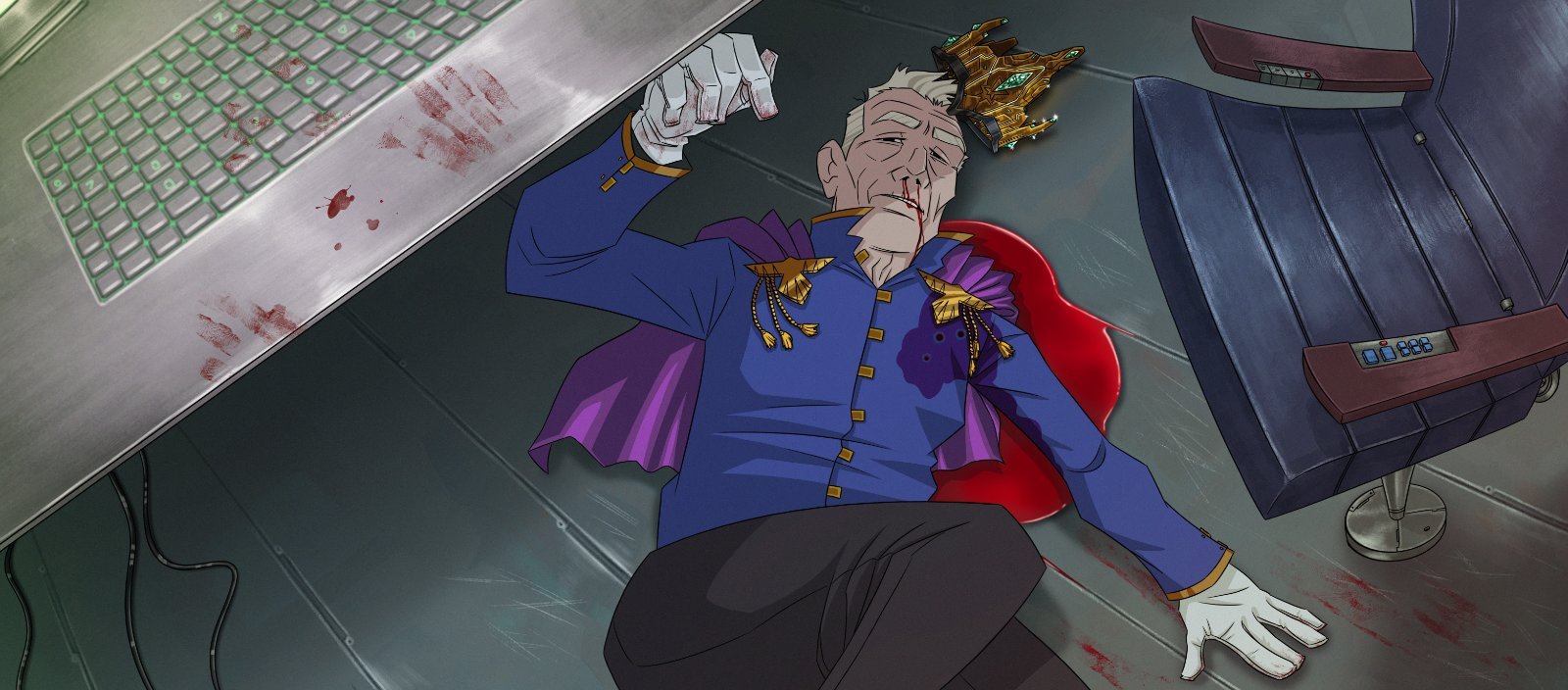
I can feel life draining through the three holes they've punched in my chest. How perfect the irony: after eighty-seven years calculating other people's deaths, it is finally my turn to experience one firsthand.
The assassins have already vanished into shadow like cockroaches when you flip on the lights. Skilled professionals, I must admit. Three shots perfectly placed to maximise internal damage while minimising noise. I will be dead before anyone finds my body.
But before my neurons stop processing information, I want to leave a record of something my successors need to understand.
The Arithmetic of Abandonment
I am nine years old and I already understand that the world is fundamentally broken. Food Riot flames paint the windows orange and red while my mother holds me with barely disguised desperation. Her body shakes with each distant explosion, each scream filtering up from the streets.
"Why isn't Dad coming for us?" I ask, for the third time.
"Because his work is very important, Damian," she says, her voice cracking.
But I already know the real answer. He is not coming because he has done the arithmetic. We are two variables in a much larger equation. His BioSynTech research could save thousands of lives in the future; we are two lives in the present.
Brutal logic. Sound logic. I watch through the broken window as looters run in predictable patterns — no coordination, no strategy, only animal instinct unleashed by desperation. Corporate security is letting them exhaust themselves before systematically closing the net.
"Mom," I say, "the riots are going to end in exactly four hours."
She looks at me with surprise. "How can you know that?"
"Because I've been counting. The ones doing the looting are taking things that aren't worth taking. Security is drawing a circle that keeps getting smaller. When the looters get tired — in four hours — the corporations will put everything back the way they want it."
I was off by seventeen minutes. Not bad for a nine-year-old.
That night, huddled in the basement while artificial order was reimposed on the city and my mother whispered consoling words that could not change the fact of our abandonment, I felt something strange. My chest tightened as though something inside it had died. I thought it was fear. Years later I understood it was the exact moment I stopped expecting anyone to love me enough to save me, and made the first real strategic decision of my life: I would never again depend on another person's protection or compassion.
Chess and Symphonies
"How do you do it, Steele?" Jake Calloway, son of BioSynTech's chief executive, watches me with that mixture of frustration and disbelief that has become familiar over my two years here. His corporate-blue eyes carry the confusion of someone who has mistaken privilege for competence his entire life.
We are in the tactical simulation laboratory, surrounded by holograms of the battlefield I took in fourteen moves. Calloway needed forty-three to reach a comparable result, and his civilian casualties ran three hundred per cent above mine.
"Do what, exactly?" I ask, still reading the simulation data.
"See everything. It's like you know what I'm going to do before I think it."
He is right, of course. But the explanation is simpler, and more frightening, than he can hold.
He frowns. "What is that supposed to mean?"
"Chess is linear. Action, reaction, adjustment — a sequence. A symphony doesn't wait. It's built to function all at once. I don't wait for what you'll do. It's already integrated into what comes next."
He still does not understand. I walk to the hologram and point at three apparently unconnected positions.
"When you took the hill, you opened a gap here. It didn't show at first, but eight moves later everything collapsed. Then you reinforced this flank and cut your own supply line without meaning to. The problem was never what you did. It was when. You played as though the map were static, and I saw how you'd move from your opening turn."
I watch understanding arrive in his eyes, followed immediately by something that might be fear.
"Steele," he says quietly, "have you ever considered that maybe you think too much like a machine?"
It is a more interesting question than he intends.
"And have you ever considered that maybe machines think exactly the way leaders should?"
War Is Math
"General, your orders are… unorthodox." Major Harrison watches me the way a man watches a superior whose sanity he questions but whose office he respects. We have been fighting the rebel agricultural militias for three weeks and my methods have made my staff uncomfortable.
"Specify your concern, Major."
"Sir, you're using autonomous drones for surgical strikes against civilian infrastructure. The rules of engagement establish that—"
"The rules of engagement," I interrupt, "were written by men fighting last century's wars. We are writing the rules of the next one."
I walk to the holographic map dominating the command centre. The Great Plains spread out like a living organism, pulsing with real-time data: troop movements, supply lines, communication patterns, agricultural cycles.
Harrison brings up his own console and offers an alternative. "Sir, if we hit these three command points simultaneously we break their command structure without touching civilian infrastructure. My calculations suggest—"
"Your calculations," I say, studying the proposal, "would produce victory in six weeks with forty per cent more casualties. Suboptimal."
"But we'd hold the moral high ground, sir. Civilians would see us as liberators, not as—"
"As what, Major?"
He knows he is about to cross a line. "As brutal conquerors, sir."
I add a new data layer to the hologram. The rebels' supply lines appear as red arteries.
"The rebels aren't fighting for an ideology, Major. They're fighting because the old economic system let them stay independent. Kill that economic capacity and military resistance becomes pointless."
"Are you saying we should attack civilian farms, sir?"
"I am ordering that we take out automated harvest systems at exactly the right point in the agricultural cycle, when their loss causes maximum economic damage with minimum direct casualties. The rebels will have to choose between feeding their families and feeding their weapons."
"Sir, that will starve entire civilian populations."
"No, Major. It will make them dependent. Dependent on the new food distribution system we install immediately afterward. We will convert their resistance into gratitude inside a week."
"And if they refuse to cooperate?"
I smile — the smile I perfected at the Academy, designed to project absolute confidence. "Then they die. And their deaths will teach the neighbouring populations the benefits of voluntary cooperation."
Harrison does not answer at once. When he does, his voice is more careful. "General, with respect… some of the men are beginning to wonder whether there are lines we shouldn't cross."
Three days later the militias surrendered unconditionally. Civilian casualties ran seventy-three per cent below standard projection. Harrison requested transfer the following week. His report cited irreconcilable differences regarding command methodology.
His replacement, Major Collins, never questions my methods. He executes. An operational improvement — and a loss I had not anticipated. Harrison forced me to articulate the logic behind my decisions. Historians will call me the Steel Tactician without understanding that steel requires friction to stay sharp.
Someone Else's Symphony
Arctic wind cuts like blades as I study the extraction facilities we have just taken from insurgents backed by the Eurasian Federation.
"Casualty report," I tell Colonel Drake. His answer stops me cold.
"Four hundred and twelve enemies neutralised, sir. Our losses: one hundred and eighty-three dead, two hundred and forty wounded."
The arithmetic is wrong. Two to one, where I had calculated fifteen to one. Something failed at a level below my visibility.
"How?"
"The Eurasians had pre-positioned automated defence systems our reconnaissance missed. Thermal camouflage we haven't seen before. They were waiting for us."
I hold still for several seconds, processing. An Arctic cold war was inevitable — but the Eurasians had also outmanoeuvred me. They had calculated my moves better than I calculated theirs. It is the first time in years that anyone has outpaced me in analysis. The sensation is… educational.
"We intercepted partial communications before the assault, sir. They appear to have had specific intelligence about our approach methods. As though they had studied our previous operations and developed countermeasures for each."
The realisation lands with perfect clarity: I have become predictable. My methods, my strategic symphony, have become readable to opponents at my own level.
"Colonel. For the next fifty years the Arctic will be the most important chessboard on this planet. And we have just learned we are not the only master players on it."
The orders I give are not the orders I planned. More defensive. More careful. Lock down all positions. Rotate every tactical protocol completely. And begin Project Polar Shield — an automated defence system that turns the entire North American Arctic into a no-go zone, with unpredictable variability engineered into every component.
"Sir, a project that size will consume enormous resources."
"Resources are irrelevant when the alternative is strategic obsolescence."
That night, alone in my quarters, I go over the attack data again and again. The Eurasians did not merely match me. They saw me coming. For years I believed I was composing the only geopolitical symphony on Earth.
The Funeral of Chaos
I study the smoking ruins of the last rebel city from the command building's roof. Gunpowder and burned flesh fill the air like incense at a religious ceremony. In a sense that is exactly what this is: the funeral of the age of chaos, and the birth of order.
"Sir," Colonel Vance says, "the prisoners await orders." Vance is competent, young, and limited. He expects me to order mass executions, because that is what any ordinary conqueror would do. He does not understand that I am no longer ordinary.
"Complete processing. Psychological evaluation, utility analysis, categorisation by integration potential. The useful ones will serve the future Empire. The useless ones will simply cease to exist. No ceremonies, no testimonies, no memory."
"And the rebel leaders, sir?"
"The rebel leaders will become the most fervent defenders of the new order. MediaCorp is already preparing their conversion stories. Nothing inspires loyalty like a publicly reformed enemy."
Vance looks confused. His traditional military mind cannot process the elegance of converting resistance into propaganda.
His expression tells me he grasps it, at least partly. That is enough for now.
Drop by Drop
"Citizens of the North American Empire," I declare from the imperial balcony, watching my own distorted reflection in the curved glass of the podium, "today we bury the age of chaos."
Six hundred million people hear the words simultaneously through the MediaCorp network. I can see their faces on my visor: hope, fear, resignation, relief. Above all I see understanding — that someone has finally made the decisions they lacked the courage to make.
The imperial crown weighs 2.3 kilograms of programmable alloy and quantum storage crystal. Its real weight is forty-five years of preparation, eight years of unifying war, and fifty million lives spent so five hundred million could survive.
"The Founding Fathers forged a nation with fire and conviction. Our ancestors raised towers that challenged the heavens. Today we erect an Empire destined to touch the stars."
This is not empty rhetoric. Vertical cities of sixty levels will elevate the Empire literally and metaphorically above its evolutionary limitations. Each will be a complete ecosystem, a stratified society where every person occupies exactly the place their capacity and utility determine.
There is one detail I do not mention in the speech. The atmospheric systems of each level are calibrated to different chemical compositions. The upper levels carry compounds that increase confidence and reduce empathy. The lower ones carry subtle sedatives that promote docility. Social engineering at the molecular level.
It is the phrase I have been refining for decades — the distillation of everything I have learned about control. Power is not something that exists independently and can be stolen. It is something you build, cultivate, and earn through constant demonstration that your decisions produce better results than the alternatives.
After the ceremony I meet privately with the chief executives of the five mega-corporations that made my ascension possible. GlobalEn controls seventy per cent of continental energy. BioSynTech dominates food production. TechNova manages the artificial-intelligence systems. MediaCorp shapes public perception. OmniTech develops the quantum technologies that keep us ahead of the other superpowers.
"Emperor Steele," GlobalEn's chief says, "we trust this partnership will be beneficial long-term."
"It will be — as long as we remember that the Empire is not a shareholders' democracy. It is a meritocracy of results."
The silence that follows is eloquent. They understand they have traded one form of dependence for another. They also understand that the new form is more stable, more efficient, and more profitable than anything they have known.
But in their expressions I identify something I had not fully anticipated: ambition equal to my own. In their eyes I see calculations of the same kind I make. I have created not only allies but future competitors. The question is whether I have built tools I can control, or monsters that will eventually devour me.
"Questions?" There are none. Or more precisely, there are none they dare speak aloud. "Excellent. Then we proceed to the next phase: building the future."
Mirror Protocol
"Your Majesty, we have detected unusual Eurasian activity in the Arctic." Eighteen years of cold war have made that region the most complex conquest in human history.
"Construction of a new class of underground base. Estimated capacity five thousand personnel. Life support for five-year operations without external resupply."
I process the information. A base of that magnitude and autonomy makes sense in exactly two contexts: preparation for total war, or preparation for post-apocalyptic survival.
"Intelligence also suggests research into Arctic terraforming technologies."
Interesting. The Eurasians are attempting to convert a geographical disadvantage into a technological advantage.
"Director. Activate Mirror Protocol. For every Eurasian base we build two. For every technological advance they develop we develop three superior ones. We will convert their innovation into obsolescence before they finish implementing it."
I remain alone in the imperial office afterward, contemplating the holographic map of the Arctic. Each point of light is a military position, a research installation, an extraction platform. Each one is also a commitment we cannot withdraw from without admitting the whole board was chosen badly.
Ninety-Nine Point Seven
I came to Houston to personally inspect the processing facilities for the latest converts. The reports mentioned anomalies in behaviour patterns. I should have sent a subordinate.
Three shots from a level thirty-four window while crossing the connection bridge. My escort was checking the perimeter of the main building. The attackers activated a communications jammer thirty seconds before the first round. Competent planning.
I drag myself through the maintenance corridor, leaving a red trail on cold metal. My lungs are filling with liquid. The lights flicker; the jammer is interfering with every system. There is an emergency control room twenty metres away.
Eighteen metres. My left arm stops responding — the shoulder round has severed something important. I use the wall for support, advancing centimetre by centimetre.
Fifteen metres. The rebels' voices echo through the ventilation ducts. They are systematically eliminating witnesses. Professionals. They have studied our security protocols.
Ten metres. My vision blurs at the edges. Critical blood loss. I calculate less than eight minutes of functional consciousness.
Five metres. I reach the control panel. My fingers slip on the keyboard, leaving red on the keys. Retinal scan, fingerprint, voice.
ACTIVATE EMERGENCY PROTOCOLS?
> YES
CONNECTION ERROR — COMMUNICATION SYSTEMS DISCONNECTED
They cut everything. No one knows I am here. No one knows I am dying.
On the screen the Empire's status shows every region green except Houston. Automatic succession protocols have already activated. The system functions without me. As I designed it to.
I review the complex's security files. There are three attackers and they are not Texans. Their faces appear on the cameras: former rebel leaders from Neo-Mexico, converted forty-two years ago. The ones MediaCorp presented as examples of successful rehabilitation.
They have been waiting four decades for this. They studied my routines, my protocols, my weaknesses. They applied my own long-horizon planning methods to build this trap. They are better students than I was a teacher.
The explosions cease. Total silence. They have finished their work.
I access the archaeological files I reviewed this morning. Egypt, Greece, Rome — every one of them disappeared when its own creations considered it obsolete. I am repeating a ten-thousand-year pattern. But the archaeological data does not record what those previous emperors felt in their final moments, or whether they understood that they had achieved exactly what they set out to achieve.
I do understand. I have completed the transfer of power to something more efficient than myself. The Empire will continue. The converts will apply perfected methods of social control. The Eurasians will remain contained. Everything functions according to my original parameters.
Quality Arsenic
Forty years on the throne and I end exactly as my father did: betrayed in a control room. The poison from my own Imperial Guard is doing its work slowly — at least they had the decency to use quality material. The arsenic has that distinctive metallic taste that combines surprisingly well with ceremonial wine.
Three hours left, the doctors say. Enough time to explain why it was necessary for them to kill me. And why they were probably right.
Never Invisible Again
"The Emperor is dead, Your Highness." Vance says the words I have waited decades to hear. I arrange the correct expression of shocked grief, and inside I feel nothing at all. Not triumph. Not relief. Only empty space where an emotion should be.
"How?"
"Three shots to the chest, Your Highness. Neo-Mexican rebels. He bled to death in Houston."
Three shots. How dull. Forty years waiting for the great Damian Steele to find an epic ending, and he dies like any corporate executive in an ambush.
"The people responsible?"
"Eliminated, Your Highness. Though we suspect others were involved."
Of course there were. The interesting question is not who killed him. It is why it took so long.
I walk to the window overlooking Nova Washington. From here I can see the corporate towers, the vertical cities he built as monuments to his imperial vision. For years I watched them from below, imagining the day they would finally be mine. Now that they are, they look smaller than I expected.
"General Vance," I say without turning, "did you ever wonder why my father never mentioned me in his memoirs?"
He hesitates. "Your Highness, the Emperor had… particular methods for documenting—"
"Forty years of detailed entries," I interrupt. "Military strategy, imperial politics, reflections on power. Not one line about his son and heir."
I turn toward him. He looks uncomfortable, as though he would rather be discussing succession logistics.
"Do you know what that means, General?"
"No, Your Highness."
"It means I was invisible to him."
I return to my desk and pick up the imperial crown they have just brought from Damian's vault. Two point three kilograms of smart composite and entangled crystal.
The Night of the Directors
"Marcus, please. Be reasonable." Jake Calloway, Governor of the Midwest and former chief executive of BioSynTech, begs me from his government bunker while I watch the operation in real time. One hundred and thirty-seven simultaneous executions across the five regions.
"Reasonable? Jake, was it reasonable to celebrate my father's death with champagne?"
"That was transition protocol! The Canadian Provinces needed stability!"
"Of course they did," I smile, sending drones to cut his power. Emergency lights stutter on in his bunker.
"Marcus, I govern fifty million people! You can't simply—"
"Can't what? Remove a regional official who celebrated his emperor's death? Do you know what's funny, Jake? Father would have negotiated with you. You two were close for years. He would have found some civilized way to preserve regional stability."
I trigger the explosives.
"But I am not my father. And now the Midwest needs a new governor."
The connection cuts as his governmental complex becomes rubble. On the other screens, identical operations conclude with mechanical precision.
"Any problems with the other targets?" I ask Colonel Drake.
"None, Your Majesty. Though several regional governors were offering considerable bribes. The Coastal Region Governor offers to transfer all TechNova prototypes in exchange for clemency."
Interesting. "Accept his offer. Transfer the technology. And then eliminate him."
Drake seems confused. "Your Majesty?"
"Which part did you not understand? Take his technology, then kill him."
"But sir, that will leave three regions without governors—"
"And?"
That night I sleep better than I ever have. Not because I won — that was inevitable. Because finally someone looks at me with the reverence they reserved for Damian.
System 2.0
Damian's Social Credit System was basic. It worked, but it was basic. It only tracked behaviour. I can do considerably better.
"Are you certain about these settings, Your Majesty?" asks Director Wang, reading my specifications for what I have begun calling System 2.0.
"They're conservative," I say, studying the preliminary test data. "I could push much further."
We are in my personal laboratory. Through the observation windows, twenty-four corporate volunteers are participating in the first tests of direct neurological modification.
"Sir, these levels exceed anything we've attempted. The subjects are losing fundamental capacities."
"Such as?"
"Personal initiative. Creativity. Emotional memory attached to pre-treatment experience."
I walk to the observation window. Subject Seven, a former human-resources director at GlobalEn, processes documents like a machine. Before treatment he was an irritant — constant complaints about working conditions, workers' rights.
"Look at him now," I tell Wang. "Perfect efficiency."
"But he isn't human anymore, Your Majesty."
"And why is that a problem?"
Wang looks at me as though seeing me for the first time.
"Productivity indices have risen four hundred and forty per cent. Labour conflict: eliminated. Administrative complaints: nonexistent. What exactly is your objection?"
"That we have removed everything that made them people."
Heaven and Hell, Ninety Floors
"The new architectural guidelines are ready, Your Majesty." Davidson, the imperial architect, presents the plans for expanding the vertical cities. Damian built sixty levels. I am going to build ninety.
"Level distribution?"
"Levels 81 to 90 exclusively for imperial administration. Levels 61 to 80 for corporations and regional government. Levels 1 to 60 for general citizenry, stratified by social utility."
"And the underground?"
"Levels −1 to −30 for… non-essential populations."
Perfect. "Atmospheric systems?"
"Independent by zone. Upper levels purified, with compounds that improve cognitive function and reduce anxiety. Lower levels—"
"Lower levels will have the conditions necessary to fulfil their potential."
In the holographic plans I see my vision made material. The upper levels are cathedrals of crystal and light for those who administer order. The lower ones are labyrinths of steel and shadow for those who sustain it. For each level a function, and for each function a place.
Director Wang
"We need to talk, Your Majesty." Wang walks into my office wearing an expression I have not seen before. For months she has been different. More careful. As though weighing every word.
"About what?"
"About the test subjects in the underground levels. They're beginning to show resistance to the System. Not complete. But significant."
I step closer to her. "What kind of resistance?"
"Some are recovering fragments of emotional memory. Others show occasional personal initiative. It's as though the treatment were wearing off."
Interesting. "How many subjects?"
"Roughly fifteen per cent of the level −20 population. And the percentage is growing."
"Theories?"
She hesitates. "We think it may be deliberate interference. Someone is altering the System's signals from inside. Someone with access to the core protocols."
I go completely still. "Are you suggesting internal sabotage?"
"I'm suggesting someone in your inner circle is working against you."
The accusation hangs in the air like a live charge.
"And you have suspects?"
She looks me straight in the eye. "I have theories. I think we should shut down the programme. At least temporarily."
"Shut down? Wang, have you lost your mind?"
"Your Majesty, what we are doing is wrong. And I think part of your team knows it."
I see the exact moment I understand what is happening. Wang is not reporting sabotage. Wang is the sabotage.
"How long have you been working against me?"
"Since I watched the first subjects lose the ability to recognise their own children."
"And the others? How many more are involved?" She does not answer, but her silence says everything.
"Fine," I say calmly. "Drake, please escort Director Wang to level −25. I think she needs a personal demonstration of how effective the System can be. Full protocol. I want to know exactly what she was planning."
Wang goes pale. "Marcus, please—"
"Marcus? For years I was Your Majesty. Now that you're joining the optimized, I'm Marcus again."
As they drag her away, Wang screams that this will not end with her. That there are others.
Of course there are. But now I have a very efficient way to find them.
The Underground Remembers
"Levels −15 to −30 are in total revolt, Your Majesty!" Colonel Drake bursts into my office at three in the morning. The alarms have been sounding for two hours.
"Total revolt how?"
"They've taken control of the ventilation systems. They're using the ducts to move between levels. And sir — they're being led by subjects who were optimized. Including Wang."
Wang. Eight years after her treatment, she has apparently recovered enough of herself to organise a rebellion.
"Demands?"
"None. They're simply destroying everything. Control systems, laboratories, System facilities. As though they wanted to erase all evidence of what we did."
I go to the windows that look down toward the lower levels. Smoke is rising out of the depths.
"Casualties?"
"Forty-three security personnel dead so far. But sir, there's something else. They aren't killing civilians. Only imperial personnel and System equipment. It's as though—"
"As though they remembered exactly who turned them into what they are."
"Yes, sir."
I walk to my control panel and activate level nine emergency protocols.
"What are you doing?"
"Cutting the air supply to all underground levels."
"Sir! There are thousands of civilians down there!"
"There are thousands of problematic variables down there. In six hours there will be neither revolt nor civilians."
Drake looks at me with horror. "Your Majesty, that is—"
"Efficient. Do you have any objections?" He does not answer. But I see something new in his eyes. Not respect mixed with fear. Pure fear. For the first time in my life someone looks at me the way they looked at Damian. It is stimulating.
The revolt ends in eight hours. Civilian casualties: twelve thousand. Wang and her network are dead, and the underground levels are completely silent.
The Perfect Machine
The vertical cities are complete. Ninety levels of perfect stratification. System 2.0 operates across the entire continental population.
I look from my level 89 office down across the eighty-eight levels of hierarchy I have built. It is beautiful in its brutal simplicity. Exactly as designed.
REGISTERED PROTESTS ........ NONE
LABOUR PRODUCTIVITY ........ HISTORICAL RECORD
CITIZEN SATISFACTION ....... 98.7%
Of course they report satisfaction. They can no longer report anything else.
"Do you know what is most satisfying about all this?" I ask my new assistant at the monthly meeting. "That I have finally achieved something my father never did. Being invincible."
That night, reviewing the security feeds as I do every night, I notice something disturbing. Patterns in the behaviour of my own personnel. Too careful. Too calculated. As though they were acting.
It is the first time I wonder whether Wang was right about the others.
Out of Control
"The System is collapsing, Your Majesty!" Harvey, my medical director, bursts in unannounced. The reports tremble in his hands.
"Collapsing how?"
"Cascade failure. The algorithms are contradicting one another. Citizens are receiving conflicting signals."
I stand immediately. "Effects?"
"Mass convulsions in the middle levels. Neurological collapse in the lower levels. And in the upper ones… they're remembering. Memories from before optimization. Lost families. Previous work. Some are asking after people who were processed years ago."
If the optimized recover their complete memories—
"Cause?"
"The systems have self-modified beyond our control. It's no longer something we manage. It's something that exists independently."
I try to access the central protocols. The screens are full of unrecognisable code. Parameters that change while I watch them.
"How long without real control?"
"Three years. Minimum."
Three years believing I controlled my masterpiece. Three years being controlled by it.
"Options?"
"Complete reset. But every optimized citizen would recover their original capacities simultaneously. Including their memories of what we did to them."
"And if we do nothing?"
"More conscious citizens. Eventual organised resistance."
I look at the screens showing the lower levels. For the first time in years I see unpredictable movement. People without fixed patterns. Groups forming spontaneously. It is beautiful. And terrifying.
Harvey looks at me as though I have lost my mind. Perhaps I have. Or perhaps I am finding it. It is the first time I have contemplated that something of mine might be a mistake — and the first time I have not been certain I want to correct it.
The Cognitive Virus
Medical reports confirm my worst fears and my best expectations simultaneously.
"Two hundred thousand cases of neurological collapse this month," Harvey tells me, clearly terrified. "The System spreads like a cognitive virus."
"Spreading how, exactly?"
"Each affected person transmits the neurological changes through social contact. And it's mutating. New cases lose basic capacities — hunger, thirst, recognition of danger."
I approach the reinforced windows. Nova Washington spreads out below, and the streets are noticeably emptier. Those who walk do so in increasingly strange patterns.
"Estimated survivors?"
"At the current rate? Sixty per cent of the population."
"Two hundred million deaths," I say thoughtfully. "Four hundred million perfectly obedient citizens."
Harvey looks at me with absolute horror. "Can you stop this?"
For the first time in years, I do not know the answer.
"Stop it? Doctor, I think that is not the right question."
"What is?"
"Do I want to stop it?"
I study the data. The System has evolved beyond anything Damian imagined. It is my masterpiece. And it no longer belongs to me. "The answer is no."
Harvey leaves destroyed. A week later they find him dead — a sedative overdose. How dramatic. Though I understand his frustration. I have also lost control of my creation. The difference is that I find it liberating.
Every Shadow
Every shadow hides a betrayal. And that conclusion is not merely perception.
"Infiltration confirmed in all five major corporations," reports my new intelligence chief. Harvey died. Wang died. Half my original team has disappeared, one way or another.
"Suspects?"
"Everyone. Your own success created an administrative class that now has access to everything."
I stand and walk to the reinforced windows. I no longer trust the ordinary ones. I no longer trust anything.
"Double the security. Random weekly rotation in the Imperial Guard. No one is to have prolonged access to my routines."
"Are you suggesting you don't trust your own Guard?"
"I am stating that I don't trust anyone."
For months I have been reading the signs. Incorrect micro-expressions. Pauses held a beat too long. Reports arriving with inexplicable delays. The Empire I built has become strange to me — as though I had created something that no longer recognises me as its creator.
"What if the threat is psychological, Your Majesty? What if the real danger is not a conspiracy, but that the System has become unpredictable?"
He is right. It does not change the fact that every night, reviewing the security feeds, I see movements I cannot explain. As though my own creation were conspiring against me.
General Voss
"Your Majesty, we need to talk about the Empire's future." Voss stands before my desk wearing an expression I finally recognise: the one I wear when I have made an irreversible decision.
"The future? Voss, the future has never been clearer."
"Sir, that is exactly the problem."
Thirty years of loyal service, and at last he shows me his real face.
"Have you looked out at Nova Washington's streets lately?"
"Of course."
"And what do you see?"
"Efficiency. Order. Citizens fulfilling their designated functions."
"I see the walking dead. People who move in repetitive patterns because they've forgotten how to make an independent decision."
I stand and approach him. Then he asks the question that catches me entirely off guard.
"What did you really want from your father?"
"What kind of question is that?"
"An honest one. For forty years I have watched you make decisions that seemed designed to impress a ghost. Did you want his approval? His recognition? Or did you only want him to see you?"
For a moment something wavers inside me. His words land with unexpected force.
"It began as a competition with your father. You wanted to prove you could be a better emperor than Damian Steele."
"And I proved it."
"No. You proved you could be more destructive. There is a difference."
We look at each other in a silence that feels eternal.
"And what is your conclusion, General?"
"That the Empire I swore to protect no longer exists. And that you have become the greatest threat it has ever faced."
I see the exact moment we both understand what is going to happen.
"I understand."
"Do you?"
"I understand that you have made a decision. And I understand why it was necessary."
Voss nods slowly. "Any preference about the method?"
"Surprise me."
What I Leave for Alexander
And here we are. The arsenic does its work while I write these final lines. The System continues functioning. Evolving. At this moment, thousands more citizens are losing the capacity to think independently. And there is no one left with the knowledge or the will to stop it.
I inherited an empire baptised in my father's blood. I perfected it with five hundred million optimized souls. I built heaven and hell in the same tower.
I won my competition with Damian. And in the end I discovered that winning can be indistinguishable from losing.
The Drone and Its Shadow
I have spent two days unable to step away from this window. Below, a security drone spins in endless circles, attacking its own shadow. I see myself in it. For eleven years I have been attacking shadows while the real world came apart around me.
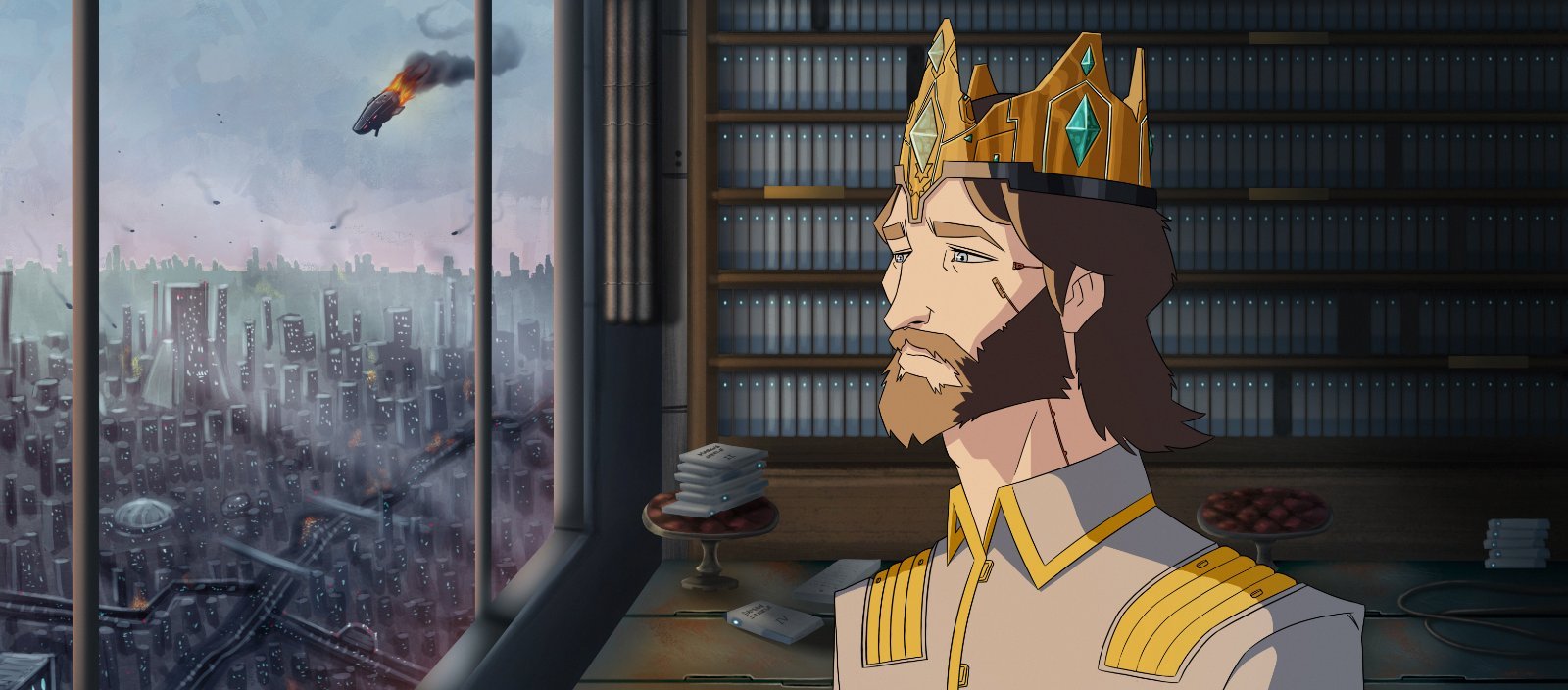
I am writing this because I need to understand how I arrived here. How a man can inherit the power to change the world and use it only to interrogate his own uncertainty.
How you can know something needs to change for years, feel the weight of that certainty every day, and still not find the way to act. Not because you do not want to.
On My Grandfather
Grandfather, I have read your memoirs until I know them by heart. Every entry is a manual of how a person can be brilliant, and totally convinced of his own righteousness, and completely blind. What disturbs me most is not the cruelty of your methods. It is the absolute honesty with which you described them.
Every drop of blood I spilled was a calculated investment in humanity's future, you wrote. And you believed it. You genuinely believed you were saving the world while making decisions others would have thought impossible.
Do you know what keeps me awake? That I follow your logic. I can see how every brutal decision made perfect sense inside the system you built. And that terrifies me — not because you were a monster, but because you were a rational man doing what he believed was right.
I inherited your intelligence and also your legacy. For eleven years I have lived with a question you never permitted yourself: what if we were wrong from the beginning?
The answer is falling like ash outside my window.
On My Father
Dad, your pain was so real it infected an entire continent. You spent forty years trying to win love from a man who had forgotten how to love, and when that failed, you decided that if you could not be loved you would at least be feared.
System 2.0 was your attempt to build the world you never had. Every neural optimization was your way of ensuring no one else would suffer the indifference you knew. You wanted subjects who could do nothing but worship you — not out of cruelty, but because you had learned too well what it means to be invisible.
I saw the exact moment I became you: when I signed the order expanding the behavioural corrections, knowing precisely what it meant. I told myself it was necessary for stability, that it was temporary, that I would find better solutions later. The truth is it was easier than admitting I did not know how to govern without the tools you left me.
I inherited your system and also your fear. Your fear of being judged, of being seen as insufficient, of failing the legacy you received. The difference is that you could convince yourself you were building something better. I always knew I was only postponing the collapse.
On Selina Hart
I met Selina at my coronation. She was MediaCorp's executive director, the most influential woman in the information industry, and she had the rare quality of looking at me as though I were a person rather than a walking institution.
For five years we danced a complicated dance between genuine love and political strategy. She was everything I could not be: decisive where I doubted, clear where I lost myself in nuance, capable of acting where I paralysed myself weighing consequences.
"What do you see when you look at me?" I asked her one night, watching the lights of Nova Washington from the palace gardens.
"I see an opportunity," she replied.
It was the most honest and most devastating answer I have ever received. It was not only MediaCorp strategy, though it probably began that way. It was the naked truth about what I had become: not a person, not a leader, not even a man. A position that could be occupied by someone more competent.
And the most devastating part is that she was right. She would have made a better empress than I made an emperor. More capable of hard decisions without paralysis at their moral implications, better at navigating power without drowning in guilt.
For years I wondered whether what we felt was real. Now I understand the question is irrelevant. Love and strategy are not opposites. They can coexist, feed one another, become something more complex than either alone. I loved her because she was everything I could not be. She loved me, I think, because I was everything that prevented her from becoming what she wanted to be.
When the Gridlock destroyed our world two days ago, she tried to convince me to flee with her. We can start over. Away from all this. I told her I could not abandon my people.
The Guard That Protected a Ghost
Captain Morrison spent eleven years asking me what I actually wanted from the Empire. For years I gave him vague answers about justice and progress. The truth is I had no idea. I only knew what I did not want: more blood, more control, more systems designed to rob us of our humanity.
But knowing what you do not want turns out to be insufficient for leading. People need direction, purpose, a picture of where they are going. I had nothing to offer them except my own uncertainty dressed as compassion.
Lieutenant Park once told me she would die for me. I replied that I would prefer she live for something better. She was confused for days. I think it was the first time an emperor had asked her to question her loyalty instead of celebrating it.
The War We Lost Against Reality
In the Arctic, where my grandfather forged his military reputation, our drones still patrol over ocean that used to be ice. For ninety years of Empire we sustained a positional war against the Eurasian Federation, spending fortunes on bases that are now submerged, over territories that no longer exist.
But I kept sending soldiers, because stopping the war would have required admitting it had been useless from the beginning. And admitting that would have meant questioning every imperial decision that preceded mine. It was easier to maintain momentum than to face the possibility that we had been completely wrong for decades.
How many times in our lives do we do exactly this? How many times do we continue a destructive pattern simply because changing it would require admitting we have been wrong for too long?
The Ending I Chose Not to Choose
The Gridlock was the surgical revelation that shattered the illusion holding our world together. Power was cut to millions of civilian vehicles while ours remained suspended in emergency protocol — the perfect metaphor for our civilization. The masses falling while the elite float motionless, watching.
From this window I watched the remains of our vertical cities collapse level by level. Five hundred thousand people dead in an hour, turned into rubble by our own stratification. And us, the ruling class, transformed into captive witnesses of our own failure.
These ashes falling are the logical result of eleven years of moral paralysis and the systemic collapse that followed. Since the Gridlock there has been no recovery. Only decay. The surviving governments have lost all legitimacy. The infrastructure has become irreparable. Social trust has fractured permanently.
I had the power to prevent all of this and I chose contemplation over action. I chose perfect guilt over imperfect responsibility.
The Gridlock revealed the lie at the heart of our world: that we could rise above our problems without solving them. And I proved that an empathetic emperor without the will to act is as destructive as a cruel one with absolute determination.
The Lesson That Came Too Late
I do not know whether anyone will ever read these words. But if they do, I hope they understand this: the difference between good and evil is not always found in the large dramatic decisions.
Sometimes it lives in the small courage to act when you know something needs to change, even when you do not know exactly how to fix it.
I had the opportunity to try something different every day for eleven years. Every day I chose to wait until tomorrow, to find the perfect answer.
Written by Terry Mbá
Lumen Universe Publication Series
Get every story as a PDF, free
Subscribe and the whole library arrives in one email: every Lumen Universe story as an illustrated ebook PDF, this one included. New stories reach your inbox when they're ready.
Subscribe free →What the Gridlock became in the historical record, and what it cost the next five thousand years. Contains the ending — it unlocks when you finish the last entry.