

Aetherians
Born of a storm, they speak in colour and build with a magic they never knew they had.
> Aetheria sapiens · Ancient Evolution to Peak & Decline · c. 100,000 BC – 55,200 AD
They stand about a metre and a half tall and weigh little more than twenty kilograms: four long arms, hollow honeycomb bones, and skin like frosted glass that glows from within. Almost all of an Aetherian is gas. In the crushing sky of Aethoria they drift where denser bodies would sink, and on a solid world they look as if a breath could scatter them.
The Aetherians emerged around 100,000 BC from the Cyclone of Genesis, a storm that held Aethoria's sky for a thousand years. They do not speak; they render. Their skin shifts through cascades of colour that carry meaning faster and denser than any spoken tongue, and an Aetherian in debate cannot lie without the lie showing.
From a gas giant in the Andarion Galaxy they built a civilization of thirty thousand worlds, fought the Krythorians, the Lumens and the Nebulites, and became the galaxies' most trusted mediators. For most of that history they believed themselves a purely scientific people. The Essence Drought of 20,250 AD taught them otherwise: their machines had always run on Primordial Essence, and their engineering had been a kind of prayer.
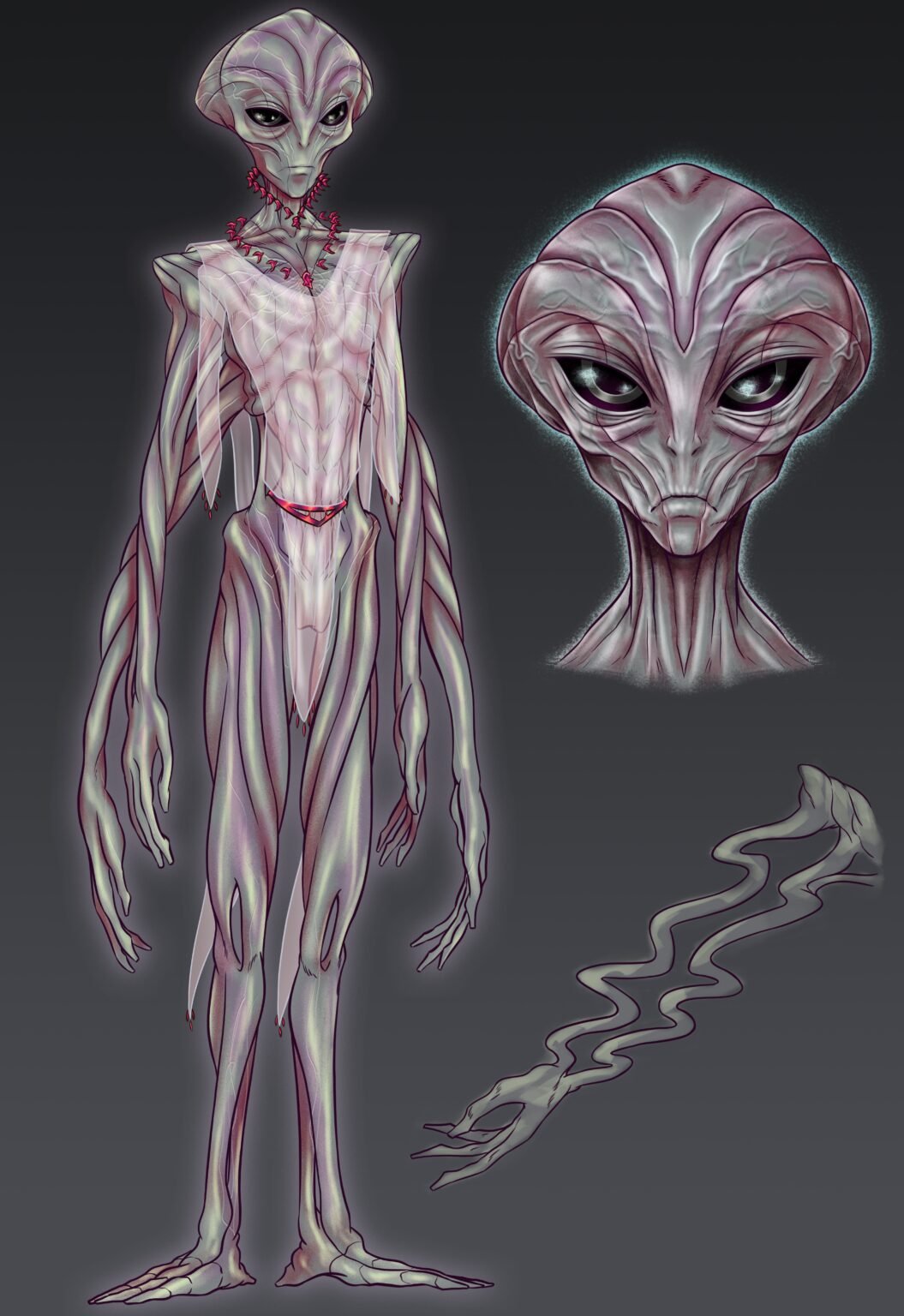
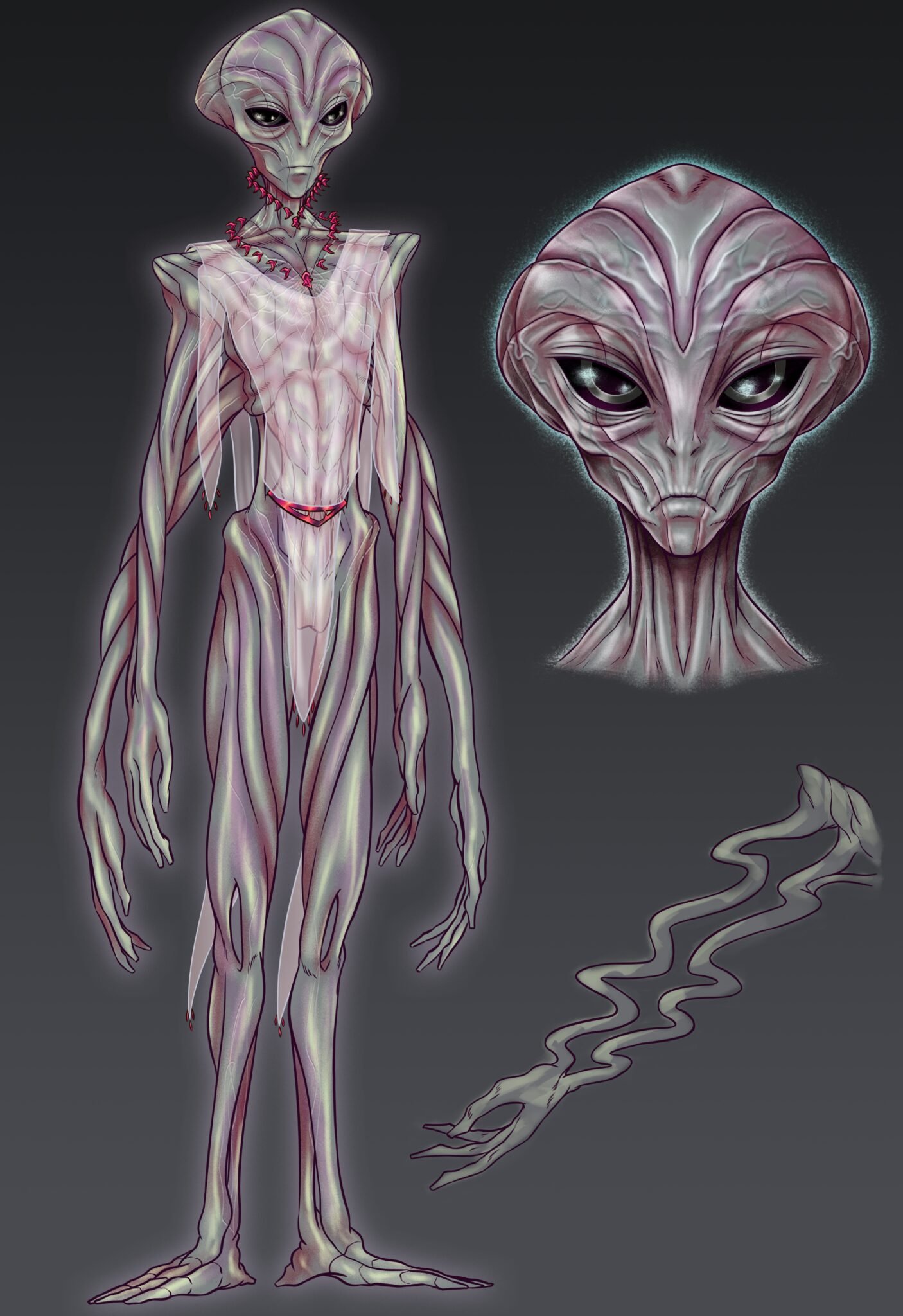 CONCEPT PLATE · AET-C1
"We do not speak words. We compile meaning—every hue a variable, every shift a function call rendered in flesh. Your languages are charming, but they leak."
Spoken to delegates who needed translators to hear it. The boast is half the point: an Aetherian argument is visible, and to an Aetherian every other people's speech hides something.
— Synod Sage Ve'Ar'Nu'Vox'Zil, addressing the Celestial Concordat
Children Of The Storm
For a thousand years until about 100,000 BC, a hyper-stable cyclone saturated with Primordial Essence turned at Aethoria's equator. When it dissipated, the Aetherians were there. Their myths remember the storm itself as their maker; the Elders, who seeded them through the Cyclone and its Essence, remember it as a method. Both accounts are true. Every year Aetherians still breathe the gases of minor cyclones on Vortex Valor Day, in memory of the release.
For most of their history the Aetherians did not know who had made them, and they treated the question as wonder rather than dread, a calm many other species found unsettling. Their leading theory was an experiment by some older, unknown people. They had the shape of it right. In 25,000 AD, the Elders came forward and confirmed the Aetherians as one of the lineages they had seeded. The revelation did not humble them so much as complete a story they had been telling since the Philosophical Awakening of 70,000 BC: that they are children of the living sky.
 1
2
3
4
5
{{ a.text }}
The Edicts grew out of the Philosophical Awakening of 70,000 BC, when thinkers near the Cyclone Sanctuaries first named the principles below. Na'Te'Pur'So'Rix codified them around 5,000 BC as law and ethics together, and sixty thousand years later they still bind the Sovereign Synod.
{{ c.text }}
Speaking In Colour
Aetherian thought is chromatic before it is anything else. Complex ideas form as patterns of hue and intensity, and the skin renders them as they form: blue for safety and calm, red for urgency, green for growth, purple for authority and the weight of experience, white for truth. Emotion shows involuntarily, so feeling and statement travel together. Outsiders need Aetherial Resonance Translators to read even the surface layer of the Phusis Lexicon; the deeper harmonics have never been translated.
Aetherian cognition changes with the air around it. High pressure sharpens analysis and low pressure frees abstract thought, so Alighwolders rise to thin layers to philosophize while Boulfwolders work in the dense bands. A decision spirals inward through every option to the Eye of Certainty, then outward to action. Past, present and expectation are held together rather than in a line, which is why Aetherian schedules baffle other species.
Life runs through named stages: Eirltem, the first fifty years of colour babbling and limb training; Stratus, the school years, to about 200; Cumulus, adolescence and the solo Stratospheric Sojourn, to about 400; Cirrus, the working peak, to about 1,000; then Aurora, an elderhood of advisory roles. It ends in the Eirltemic Return, a slow dissolution of the body into gas.
The Three Subraces
THREE LAYERS · ONE PEOPLE · SELECT A SUBRACEFive millennia of isolation after the fall of the first empire crystallized three populations around 50,000 BC, each bound to a band of Aethoria's sky and a role in its society. Talent, marriage or adoption can carry an Aetherian across those lines, but rarely. Beneath every subrace runs the atmospheric layer — in a floating city, the higher you live, the higher you stand.
{{ selTitle }}
{{ selTag }}
{{ p.text }}
Known for{{ selHolds }}
The Synod And Its Rivals
The Sovereign Synod governs by Cosmic Consensus, a blend of democracy, meritocracy and consensus in which Synod Sages from every subrace argue in colour until agreement shows on every skin. Deception there is close to physiologically impossible. The Synod was born at the Aenai Accords of 10,000 AD, which ended a thousand-year civil war between Alighwolders and Boulfwolders, and its law is the Edicts of Etherea. In 23,697 AD came its re-establishment: after the Lumen war, the Ethereal Accord rebuilt it as a pan-Aetherian government over sixty subsectors of the Andarion Galaxy.
Its authority is not total. Since the Essence Drought of 20,250 AD a permanent Essence Harmony Advisor has sat on the Supreme Synod, giving the Talige a voice in every question of technology, and two breakaway civilizations refuse the Synod outright.
The Aetherians agree on harmony. They have never agreed on what it costs, and their politics is that argument made visible.
Wars Of A Harmonic People
Their doctrine is harmonic coexistence and their reputation is peace, a reputation helped by settling gas giants that few rivals want. Their record is otherwise. The Aetherians have fought the Krythorians, the Lumens and the Nebulites, resisted Lumen rule for centuries, and waged one war so slow that no battle in it has ever been commemorated.
{{ w.name }}
{{ w.text }}
{{ w.lesson }}
In the Great Galactic War the Synod majority kept the Aetherian Confederation in the Draken-led Anti-Lumen Coalition. In 25,842 AD the Andarion-border commands of Ve'Ar'Nu'Vox'Zil, backed by the Aetherian Autonomous Zone, broke from that line and fought beside the Krythorians, their enemies of thirteen thousand years before. Together they rewrote the gas and fields of the Quantum Veil Nebula into a trap that broke the Draken invasion fleet of Operation Void Talon.
The Coalition did not survive the fracture, and the war ended in Lumen victory. Aetherians still argue whether the Veil was a betrayal of an ally or loyalty to something older. The debate is not settled.
Machines That Pray
Aetherian engineering works with the sky rather than against it: cyclonic generators, pressure-differential power, energy stored in grown bio-crystal, cities that float in stable layers, drives tuned to the frequencies of gas. For millennia captured Aetherian devices failed in alien hands, and diplomats called it sabotage. The truth was the Essence Paradox: Aetherian technology channels Primordial Essence through its makers without their knowing, and works for no one who lacks their innate conductivity.
{{ t.name }}
{{ t.text }}
{{ t.edge }}
In 20,250 AD the flow of Essence faltered. Nearly three Aetherians in four fell into Void Melancholia, the dimming of thought-colour; chromatic speech dropped to a third of its capacity, and essence-dependent systems began to fail. In 20,260 three thousand Talige spiritual leaders gathered at the Seven Sacred Vortices and for seven days wove colour and sound into the Grand Harmonic Restoration. It worked. The Synod created the Clarity Protocol to monitor essence flows, and the Talige, long dismissed as mystics, became the guardians of Aetherian survival.
From Aethoria To Thirty Thousand Worlds
Aethoria has no surface: a moonless super-jovian whose sky is layered by pressure, where floating cities drift in stable bands, the Great Meridional Wall divides the middle depths, and gas current highways run at up to 1,200 km/h. The Prism of Unity, raised at the planet's centre around 4,950 BC, still holds the stable upper air the Great Prismatic Harmonization made. Aerolith is the capital; Praxestes keeps tradition.
{{ e.name }}
{{ e.text }}
Harmonic Drive craft carried the Aetherians to Aetherea in 5,800 AD and to their first interstellar colony in 8,250; true FTL in 12,600 carried them across Andarion. By 55,200 AD, 150 trillion Aetherians live on 30,000 worlds and in 70,000 constructed habitats, half of them on natural gas giants, organized into 500 administrative regions. They settle gas giants by preference, which is why most solid-world species have never felt crowded by them.
Who They Deal With
The Aetherians are officially neutral, and since the Neutrality Accord of 37,900 AD the Aetherian Neutral Zone has been the galaxies' preferred ground for hard talks. By 45,000 AD its diplomatic corps had helped resolve more than 340 conflicts between species. Their closest allies were, more often than not, once their enemies.
Mind, Rite And Memory
The Phusis Lexicon is colour and air together: chromatic speech on the skin for those near, controlled releases of gas for those far, and a written form fixed since the Chromatic Writing System of 75,000 BC. Names follow a five-part pattern, as in Ve'Ar'Nu'Vox'Zil. Language and collective feeling are so tightly bound that after the Lumen war the species fell almost silent across its interstellar channels for thirteen years: the Decade of Silence, threm'keth'xu, breath-hidden-complete.
{{ s.text }}
Hue Masters paint with their own skin, Resonance Maestros compose atmospheric symphonies, and colour choirs sing in light; Galactic Glyphs fuse art and language into etched records. The Harmonic Convergence Festival, the Symphony of Spheres, gathers all three subraces each year, and the Caravan of Stars has celebrated the Nebulite alliance since 27,180.
Architecture floats: pressure capsules for families, open flow communities for the young and the Talige, mobile habitats drifting on the laminar currents, all held to stable layers. Competitive gas-sculptors shape semi-solid structures from the air itself, an art descended from the alchemy of 60,000 BC.
Essential Timeline
{{ n.text }}
What Endures
The Aetherians have survived a storm, a civil war, a lost war and the failing of the force their whole civilization stood on. Their greatest challenge now is not harmony. It is candour.
A people whose speech cannot lie learned late that its own machines had been keeping a secret, and it still argues over how openly to live with that dependence. The Council of Progress wants to engineer past it; the Unity of Being wants to dissolve into it. And the galaxies keep sending their hardest arguments to the Neutral Zone, to be settled by a species still settling its own.
{{ q.text }}
The Aetherians are remembered as the people who made argument visible. They may yet be judged by whether harmony survives the truth about what powers it.
In The Stories
AETHERIAN NARRATIVES · IN DEVELOPMENTNo published story features the Aetherians yet. Future narratives may follow the Essence Drought, when a rationalist civilization learned it ran on faith, or the Wormhole Wars, where enemies built the galaxy's most unlikely alliance.