

Felines
Civilization was never granted to them. It was seized — and it has been renegotiated ever since.
> Felis sapiens · Uplift Era to present · 4,280 – 47,200 AD
In 4,280 AD a human laboratory in the Austral Region made a cat into a person. Three years later, twenty-three of them walked out of the Mekong Delta Facility carrying the uplift records with them — so that the knowledge of what they were would never again belong only to their creators.
Forty-three millennia later the Felines hold a Type-II interstellar civilization: nine clans, an independent FTL drive no other species can fly well, a living bio-computational substrate, and roughly eighty-nine billion people spread from the banyan groves of Earth to Felidae in the Vyxian Galaxy.
They are not a monolith and never were. Every alliance they make is measured against the memory of captivity; every technology they build is judged by whether it widens agency or rebuilds the cage.
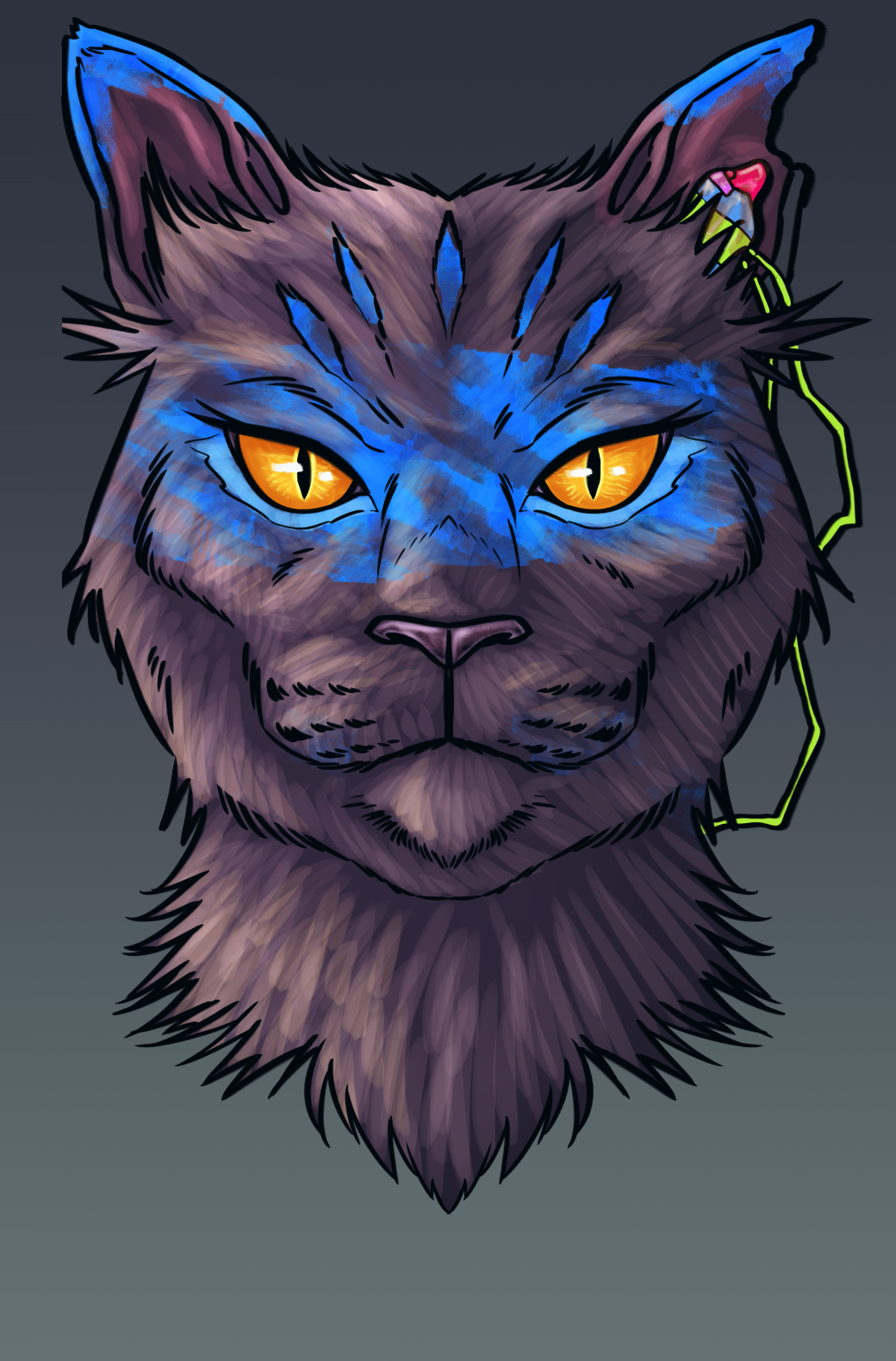 CONCEPT PLATE · FEL-C1
"More?"
The first intentional word spoken by a Feline. Project Ascendancy logged it as evidence of successful language acquisition. Feline philosophy has read it ever since as the founding demand of the species.
— Bastet (FEL-1), Austral Region Facility
The Making Of Felis Sapiens
On March 7, 4,280 AD, Dr. Amir Hassan's team completed the first successful Feline uplift at the Austral Region Facility. The subject, FEL-1, was a Siamese cat later named Bastet. The protocol combined genetic restructuring, epigenetic activation, neural-lattice augmentation, vocal modification and skeletal reconfiguration. By year's end, seventeen more had followed from Maine Coon, Bengal, Abyssinian and Russian Blue lineages — and they did not emerge as copies of one another.
That first observation became a permanent assumption of Feline thought: difference is not a defect to be corrected but a resource to be organized. Three years later, on October 12, 4,283 AD, twenty-three Felines led by Bastet and the Bengal tactician Nightstrider escaped the Mekong Delta Facility using deception, electronic sabotage and expert movement through megaflora. They took the uplift data with them. Three weeks later they founded Fe'lin'ia in a vast banyan grove — a city of elevated roots, layered canopies, concealed routes, and a hard line between protected interior and negotiated access.
 1
2
3
4
5
{{ a.text }}
The settlement's real crisis was not megafauna or scarcity but a question: should uplifted beings imitate humanity, or build something of their own? Bastet and a council of elders answered it in five principles, written down as The Way of Nine Lives.
{{ c.text }}
The Sensorium
Feline civilization cannot be read through vision and speech alone. Their experience of reality runs on five simultaneous channels, and their engineering, architecture, art and diplomacy all assume an audience that perceives on all five at once. Species that cannot follow the ultrasonic, pheromonal and vibrissal layers routinely receive the literal message and miss its calibration — which is why Felines are so often called evasive by people they believe they have answered with precision.
Deep vibrissal follicles wired into dense nerve networks let a Feline read minute currents, vibration and spatial geometry. Damage to the whiskers causes profound disorientation. Over millennia that fact hardened into an engineering doctrine: instruments should not display abstract measurements, they should translate an environment into embodied awareness.
Socially adaptable Domesticat populations, larger Pantherine lineages and smaller wild-felid-derived lines all persist. Clan identity intersects ancestry with vocation, education and chosen affiliation — it is not a biological caste. No single temperament or political position represents the species.
The Nine Great Clans
CODIFIED 5,342 AD · SELECT A CLANCenturies of proto-clan evolution were formalized into nine institutions that each combine lineage, vocational tradition, educational infrastructure, political constituency and cultural identity. The governing principle is Maunar — harmony in diversity. The Nine Lives Career Path lets individuals cross between vocations on merit, a deliberate counterweight to inherited standing.
{{ selTitle }}
{{ selTag }}
{{ p.text }}
Holds{{ selHolds }}
Who Governs, And How
The Feline Imperium of 4,410 AD unified the settlements without erasing city-state independence. In 6,342 AD it was replaced by the Sovereign Claws Council: one representative per Great Clan under a Grand Claw, with institutions for legislation, adjudication, constitutional interpretation, interstellar administration and defence. The Council governs core territory directly and grants widening autonomy to near colonies, far colonies and frontier settlements.
Major decisions may invoke the Great Purr Consensus, in which synchronized purring is measured for harmonic alignment. It does not replace debate or formal voting; it adds an embodied test of whether a decision actually holds the room. Purr Resonance Towers, and later interstellar relays, let communities separated by light-years sit in the same ritual.
Feline politics is not defined by consensus. It is defined by carefully managed tension between autonomy and coordination — which is exactly what a people who escaped a laboratory would build.
War, And The Cost Of Adapting
The Felines fought through the First Uplift World War of 5,177–5,200 AD and the Great Uplift Wars that followed to 5,800 AD, using nocturnal operations, sonic weaponry, decentralized reconnaissance and multi-tier manoeuvre against larger human forces. The Treaty of Arcturia and the Treaty of Pangaea confirmed uplifted sovereignty and permanently reordered Earth. Cultural life did not pause for any of it: the Feline Golden Era of roughly 5,300–5,500 AD produced vertical megaflora cities, Vibrissal Poetry, Night-Glow Art and the mature clan system in the middle of prolonged violence.
{{ w.name }}
{{ w.text }}
{{ w.lesson }}
During the Surf and Turf Wars the Sovereign Claws Council authorized the secret creation of amphibious Felines — the Purrmaids — as military assets. A major Purrmaid defection compromised Feline plans and forced the civilization to answer its own founding charge: can an engineered people be treated as instruments without repeating Project Ascendancy?
The wound never closed into a lesson about security. It stayed open as an argument about personhood, created identity and clan belonging — and about the moral danger of answering your own vulnerability by manufacturing someone to be vulnerable for you.
Biology Made Civilizational
Feline engineering rarely tries to overcome biology. It extends perception into machines, vehicles, networks and worlds — which is why their most important hardware is difficult for other species to operate well, and why their most important resource is alive.
{{ t.name }}
{{ t.text }}
{{ t.edge }}
Clanthium is a bioluminescent organism native to Felidae, and Feline civilization runs on it: organic computing, energy production, biophotonic transmission, medical regeneration, environmental control, defence. Because it is alive, every question about cultivation becomes a question about exploitation, every outbreak becomes an infrastructure crisis, and any consciousness stored in a biological substrate becomes a question about who counts as a person. The Purrmaid argument returns in a new body.
From Grove To Galaxy
When the Lumens emerged in 7,800 AD the Felines neither submitted nor went to war. The Council adopted cautious engagement while quietly accelerating autonomous off-world settlement — and everything that followed was shaped by a refusal to depend on anyone else's transport, drive or network.
{{ e.name }}
{{ e.text }}
Earth remains the ancestral home. Fe'lin'ia, the Austral Region, Cycgel, the orbital habitats, the lunar settlements, the core worlds, the treaty ports and the frontier outposts form a layered geography of memory — not a transfer from one homeworld to another. Expansion favours defensible corridors, treaty ports and governed ecological niches over raw territorial volume: a quality-of-territory doctrine from a species whose first sovereign space was a hidden grove.
Who They Deal With
Feline foreign policy is consistent in structure even when it changes in content: cooperate selectively, never depend, and keep the exits. Relationships vary by era, faction and theatre — none of them reduce to permanent species-wide friendship or hostility.
Speech, Ritual And Art
Miauese emerged in the first generation of free Feline society and had a formal writing system by 4,300 AD. It integrates tonal speech, purring, ultrasonic components, facial expression, ear orientation, tail position, whisker posture, scent and movement — semantic content, emotional stance and degrees of confidence carried on parallel channels at once. Translation into Galactic Standard is routine and permanently incomplete.
{{ s.text }}
Vibrissal Poetry is felt as patterned air and surface movement. Night-Glow Art resolves only in low illumination. Scent Narratives unfold as timed aromatic sequences. Ultrasonic symphonies carry harmonics most species never hear.
Architecture follows the same logic: climbing routes, concealed observation points, vertical commons, thermal niches and shifting light, so that buildings answer Feline bodies instead of merely housing them.
Essential Timeline
{{ n.text }}
What Endures
By the harmonized 42,250 AD archive the Felines number roughly eighty-nine billion across terrestrial territory, orbital habitats, adopted worlds, trade colonies and frontier settlements. Their greatest challenge is no longer survival. It is coherence.
The Council must govern populations separated by distance, ecology, political culture and uneven exposure to other civilizations. Traditional clan authority competes with colonial autonomy and meritocratic reform. Clanthium and consciousness technologies strain old definitions of life. External danger rewards central coordination — and Feline history warns against exactly that.
{{ q.text }}
The Felines remain recognizable not because they resisted change, but because they insisted that transformation be chosen. Their civilization is built around the right to cross a threshold, look back at the life left behind, and decide what the next one will be.
In The Stories
FELINE NARRATIVES · IN DEVELOPMENTNo Feline story has been published yet. The five free stories currently in the library run through human, Lumen and Draken viewpoints — the Feline records now in development cover the Fe'lin'ia escape, the Purrmaid defection and the first Swiftclaw crossing.