

Luminar
Crystalline beings who end in violent radiance — and made it their philosophy
> Luminaris radiantis · Primordial Genesis to Peak & Decline · c. 100,000 BC – 47,200 AD
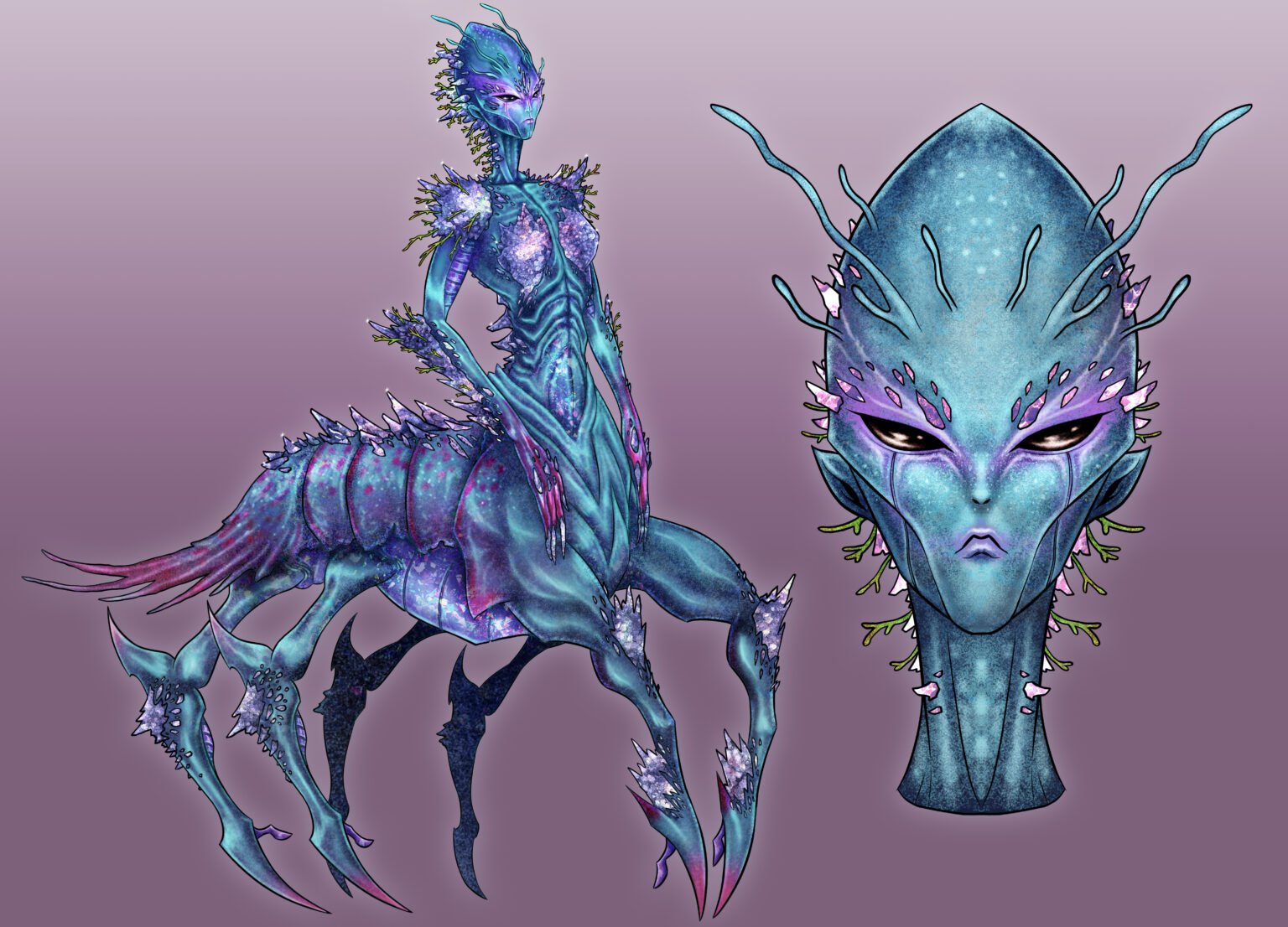
They stand two and a half to three metres tall: a translucent, iridescent upper body with two arms and a long head crowned with tendrils, carried on a segmented crystalline lower body and jointed crystal legs. They eat light. Skin, skeleton and nerves form one photonic system that stores what it absorbs, and they perceive the world as photonic gradients: how everything takes in, bends and gives back light across the spectrum. A Luminar lives about two hundred years at most.
They rose on Lumina, a crystalline moon of the gas giant Zephyros in the Upala System of the Solarae Galaxy, under the twin suns Solux and Lumia. Around 100,000 BC the Elders seeded Lumina's silica-rich strata with a mycelial network and steered its crystalline life toward thought; the modern form settled by 23,000 BC. They reached orbit in 2,450 AD and the stars in 12,800, met the Lumens in 20,500 and allied with them in 23,000.
Every Luminar knows how it will end. At death the light stored over a lifetime breaks loose at once, and an old Luminar can go off like a tactical antimatter charge. One death at Harmony Point station in 24,800 AD killed three Draken warlords and turned a border war into total war. The Luminar answered with a philosophy, vel'krisanth, the beauty that exists because it ends violently, and with a long, haunted search for a way not to die.
 CONCEPT PLATE · LUM-C1
"We do not merely capture the light — we become it. In our death, we return to the universe that which we borrowed in life: pure, unfiltered luminescence."
Ra'di'an wrote it two centuries after the war with the Draken, when the Crystal Containment Protocols had made a Luminar death a matter of treaty law. The Willing Flame read it as permission to die; the immortality researchers read it as a debt the universe should not be paid early. Every Luminar school claims the line, and no two agree on what it asks.
— Ra'di'an the Luminous, Luminar philosopher
Grown From The Crystal Moon
The Luminar were made of crystallized light rather than fire or water. Lumina's crust is shot through with photon-reactive minerals, and a planetwide fungal network, the Mycelial Matrix, threads its strata. Around 100,000 BC, the Elders seeded that network with quantum-biased strains and steered native crystalline life toward thought; whether the result was their design or an accident of their intervention is still argued in every Luminar faith. The Crystal Communion, the first organized society, rose between about 95,000 and 80,000 BC.
Over some twenty-seven thousand years of Crystalline Integration from about 50,000 BC, mineral structures grew into living tissue, a change that should have killed them and did not; some credit Elder engineering, others the Matrix. The modern form settled by 23,000 BC and has hardly changed since. The Crystalline Renaissance of 8,000 to 6,000 BC founded all three great faiths, and the first satellite rose in 2,450 AD, under the Radiant Sovereignty, a technocracy whose right to rule rested on breakthroughs. Its race for faster-than-light travel ended at the Prismatic Apex Research Station in 12,500 AD, and the people who climbed out of that disaster are the Luminar of today.
 1
2
3
4
5
{{ a.text }}
Luminar values were set down in the Crystalline Renaissance and rewritten by catastrophe: since the Apex Crisis each of them carries a warning against brilliance without caution. They are lived without privacy, because emotion shows as light and a Luminar cannot hide what it feels; dissent travels instead in frequencies the mainstream does not watch, the unseen spectrum.
{{ c.text }}
Built Of Stored Light
A Luminar is a lens that lives. It eats light, stores it, sees by it and speaks with it, and everything it has stored is still inside it when it dies.
A Luminar lives about two hundred years at most and expects nothing material to survive it. Possessions mean little when death will vaporize them, so they practise illumination investment: energy poured into people, knowledge and art that will outlast the detonation. Their language has seventeen tenses for events within one's own life, and two for everything after.
At death the lattice collapses, the stored light cascades and releases at once, and nothing of the body is left. The blast grows with age and stored energy, until an elder's can match a tactical antimatter charge. On Lumina the Mycelial Matrix steadies Luminar resonance and end-of-life pods in the Fungal Sanctuaries return the dying's light to the network; off-world, every place that hosts a Luminar is built around the risk.
Four Kinds Of Light
FOUR POPULATIONS · SELECT A LINEMillennia under different suns have given the Luminar four bodies, and the question of which is the true one has fed discrimination, immigration fights and census disputes for centuries. Homeworld Luminar call themselves lum'vethrix, children of the original light; colonial Luminar hear the condescension in it.
{{ selTitle }}
{{ selTag }}
{{ p.text }}
Known for{{ selHolds }}
The Senate After The Apex
The Radiant Sovereignty ruled for some ten thousand years on the strength of its breakthroughs, until its race for faster-than-light travel destroyed the Prismatic Apex Research Station, killed 2,847 Luminar and broke the system's networked research. Its last High Arbiter, Luminarch Sol'keth, dissolved it in 12,510 AD, telling her people they had been so bright they blinded themselves. The tri-tiered Prism Senate, also called the Prismatic Council, took shape by 12,800 AD, built so that no faction could hold unchecked power again; every session opens with a moment of darkness for the dead of the Apex, and its governing principle is caution, the hard-won rule that progress without care ends in ruin. Society is a fluid hierarchy of Luminaries, Illuminati, Radiant Citizenry and Initiates, ranked by mastery of light and contribution.
At the 47,200 AD vantage the Senate is led by High Arbiter Kri'luminex, the longest-serving since the Apex, who has refused for over a century to put the Zephyrus Question to a vote. The sharpest challenge comes from the Illustrious Shadows, Dark Crystal veterans and their heirs, who say the Luminar survived by learning to live without light, and who meet in darkened chambers the Senate has not yet moved against.
Every faction answers the Apex differently. All of them remember it.
Wars Of A People Of Light
The Luminar are defensive by habit and philosophy, and their wars came to them over what lay in their space. The longest taught a civilization of light to fight in the dark.
{{ w.name }}
{{ w.text }}
{{ w.lesson }}
At the neutral diplomatic station Harmony Point a single Luminar died, and the blast killed three Draken warlords. The archive has never settled who the Luminar was or what was intended. The war that had smouldered for three centuries became total war, and lasted nine more.
It shaped the peace as much as the war. The Treaty of Prismatic Flame was signed at a station named Harmonious Eclipse to answer Harmony Point, and its Crystal Containment Protocols made safety measures mandatory wherever Luminar go. They prevent catastrophes, and they also wrote Luminar difference into interstellar law: containment zones, residency bans, segregated quarters, and implants many Luminar find humiliating.
The Science Of Light
Luminar technology reads as autobiography: raw mastery of light before the Apex, safety and verification after it, and the bitter apprenticeship of the Dark Crystal Era.
{{ t.name }}
{{ t.text }}
{{ t.edge }}
Kel'vorith, a researcher at the Eternal Light Institute who had watched a creche-mate die young, built the Preservation Matrix to drain stored light before it could cascade, and in 38,847 AD tried it on their own body. It worked. Kel'vorith did not explode, and over the following centuries lost first visible light and then all photonic sense, becoming kris'netharak, one who exists without light. Their last message, sent from exile in 41,600, was three words: I was wrong. The Matrix still works; no Luminar has used it since.
From Lumina To The Coronaspires
Lumina, moon of Zephyros in the Upala System of the Crys'Dar Cluster, Crystalline Veil Sector, Solarae Galaxy, is the heartland: crystal canyons, the Prismatic Peaks, luminous basins lit by fungi, and the Resonance Caverns where the oldest rites are kept. At the 40,200 AD survey the Crys'Dar Cluster stood sovereign outside the LCUS.
{{ e.name }}
{{ e.text }}
Beyond the colonies, Luminar visitors live under the Crystal Containment Protocols on almost every other world, often in photonic containment zones, and some densely populated systems bar Luminar residents altogether. The Joint Luminar–Lumen Consciousness Archive keeps the alliance's shared pursuit of transcendence.
Who They Deal With
Luminar diplomacy is radiant generosity carried in a body that could detonate. Bloc lists call them neutral; in practice they are the Lumens' allies, the Draken's wary neighbours, and divided among themselves.
Light, Faith And Memory
The Luminar tongue is spoken twice at once, in sound and in light, and holds words no other language can carry: vel'krisanth, vel'luminance, kris'velen, kris'netharak. Four dialect families divide it, and the colonial ones carry political weight: some homeworld speakers call them light-starved.
{{ s.text }}
The Radiant Convergence of Prophet Kri'sol (c. 7,200 BC) worships Lux Primordialis, the shattered first light the Luminar must reunite; its Great Dimming Schism of 4,100 BC cast out the Willing Flame, who hold every death sacred and still practise ritual light-starvation. The Mycelial Confluence, shaped by Sage Trix'mycos (c. 6,800 BC), sees Lumina's network as one fragment of a universal mycelium. The Prismatic Sovereignty of Kra'zenith the Refracted (5,400 BC) calls every Luminar a unique prism, which makes every death an irreplaceable loss and immortality a duty.
Dreams come as cascades of light, kri'soleth, the light that speaks when you are not listening. Art has followed the wounds of history: classical light sculpture until the Apex, then Vel'trix the Darkened's shadow sculpture, felt only as warmth, and performance luminescence such as the Elegy for Harmony Point (25,800), performed once by 847 Luminar and never again.
Essential Timeline
{{ n.text }}
What Endures
The Luminar have outlived the Apex that broke their government, twelve centuries of war, a war fought in the dark, and a strike that killed their own people in their lost worlds. What carries them is a way of holding their end: the beauty that exists because it ends violently.
They are among the galaxy's most refined artists and philosophers and, by biology, walking ordnance, and every treaty they sign has to reckon with both. Whether they find a way not to die, or a way to stop wanting one, the light stays theirs.
{{ q.text }}
The Luminar are remembered as the people who made an art of their own detonation. They may yet be judged by whether they learned, as Sol'keth could not, to govern pride as well as light.
In The Stories
LUMINAR NARRATIVES · IN DEVELOPMENTStories featuring the Luminar are currently in development. Their 1,220-year war with the Draken, the catastrophic Apex Crisis that shattered their first government, and their alliance with the Lumen offer rich narrative territory spanning the Contact Era through the Celestial Concordat.