The World of The Last Run to Tungol
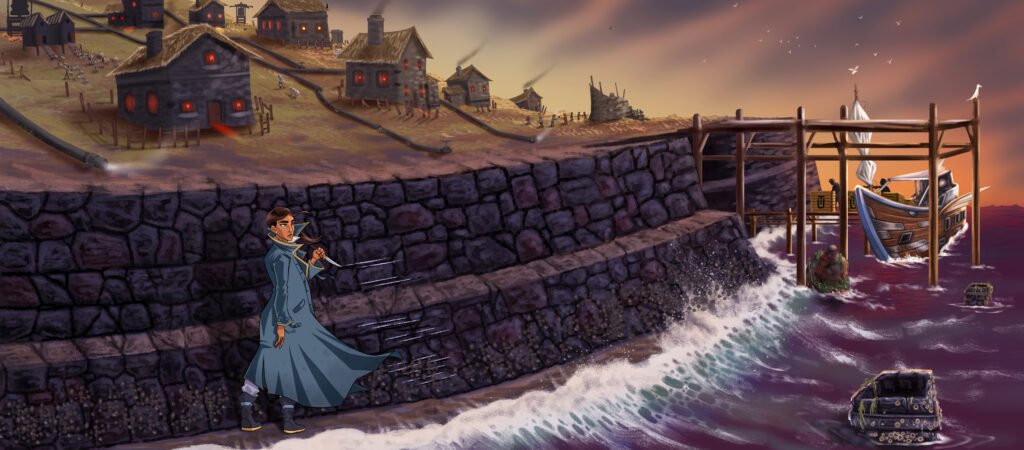
The western seawall of Tungol groans like a tired animal.
Captain Iriya stands at its crest, watching the tide creep higher than yesterday. She scratches a notch into the stone with her knife. One more line in a ledger that can end only one way. Behind her, villagers rush to lift livestock above the flood line. Children pass stones hand to hand, raising garden walls by desperate inches. Temple bells call the faithful to prayer.
“Hold fast, remain pure,” the priests chant. “The water tests us, but we must not bend.”
Iriya pulls her collar higher, hiding the barnacle-like growths spreading across her shoulders. They pulse when she stands near the sea, as if echoing some rhythm her ears cannot hear. If anyone sees them, she’ll be stoned in the square or cast beyond the wall.
Tungol’s creed is clear: no enhancements, no mutations, no corruption of the form given by the Maker.
But the ocean doesn’t care about purity. It only rises.
What Just Happened
The Interwar Peace
The Pax Sapiens Accords of 5800 AD established an unprecedented framework: thirteen delegations (six uplifted species and seven human nations) governing Earth together through the Interspecies Cooperation Initiative, which by 5950 AD evolved into the Global Species Council. For 524 years, the Interwar Period (5800–6324 AD) brought reconstruction, technological advancement, and cautious hope.
Both land-based and aquatic civilizations invested heavily in climate control and weather manipulation technologies, originally intended for environmental restoration after the devastation of the Great Uplift Wars. Aquatic civilizations steadily expanded their oceanic territories through covert weather manipulation, building asymmetric capabilities that terrestrial powers could not counter. Humans had been reduced from planetary masters to a marginal population. Their seven sovereign nations struggled for relevance in a world dominated by uplifted species.
The peace was always fragile.
The Svalbard Revelation (June 12, 6324 AD)
Scientists from the Svalbard Federation published research linking rising sea levels to deliberate weather manipulation by aquatic civilizations. The accusations were largely unfounded. Sea level changes resulted primarily from natural climate cycles and lingering Cataclysm effects. But they ignited five centuries of accumulated resentment.
Within hours, a coalition of human and land-uplift nations launched coordinated strikes against cetacean and cephalopod settlements. The Surf and Turf Wars (6324–6689 AD) had begun.
The Tidal Reclamation Doctrine (6340 AD)
Commander Kor’va’sa of the Cetacean Collective champions a new strategy: controlled flooding as a weapon. Using thermal current modulation, atmospheric moisture regulators, and polar ice destabilization, the doctrine projects complete baseline human extinction within fifty years.
This isn’t random sea level rise. It’s deliberate drowning, wielded as a weapon.
Tungol
A volcanic island-subcontinent roughly 15 million square kilometers. Larger than all of Europe. Located a thousand kilometers southwest of UniTerra across the Western Ocean. The largest stronghold of unmodified humanity on Earth.
Tungol’s population refused all genetic enhancement on religious grounds. They stayed baseline when the rest of Earth transformed. They maintained purity when purity became a death sentence. Now the sea rises higher each night, and their faith offers no answer to drowning.
The Ultimatum
By approximately 6350 AD, the Cetacean military blockades Tungol and presents the island with three impossible choices:
One: Cling to purity. Refuse all change. Tungol drowns slowly. Fifty years, but drowns it will.
Two: Accept enhancement. Let UniTerra’s modified seeds bloom with altered hands. Tungol survives, but faith breaks.
Three: Become translators. Take full enhancement, bind yourselves to the Cetacean Collective. Speak for Tungol to the sea. Surrender humanity to survive.
Every option is poison dressed as salvation.
Power Map: Tungol and the Western Ocean
Who runs things: The Cetacean Collective wields climate as a weapon, enforcing the Tidal Reclamation Doctrine across Earth’s coastlines. Their technology can raise or lower sea levels with surgical precision. To them, Tungol’s drowning isn’t cruelty. It’s balance restored after millennia of human environmental destruction.
Commander Kor’va’sa, architect of the Tidal Reclamation Doctrine, commands the strategic implementation of the flooding campaign. Cephalopod forces coordinate support operations through their bio-engineered combat organisms. Their quantum sonar arrays have already devastated coastal settlements across UniTerra.
Who’s rising: The Tungol Council represents baseline human orthodoxy: faith, tradition, genetic purity. They’ve declared neutrality in the Surf and Turf Wars, but neutrality means nothing to the tide. Their authority depends on maintaining doctrinal purity, which makes compromise impossible and survival unlikely.
The wild card: Captain Iriya. Marked by involuntary mutation. Barnacle-like growths that let her perceive Cetacean sonar communication. She represents something neither side anticipated: a fourth path between extinction and surrender.
The ocean speaks to her in harmonics she shouldn’t hear. The land condemns her for what she’s becoming. She belongs to neither world, which means she might be the only one who can bridge them.
The governed: Villagers of Tungol live between faith and desperation. They pray for the water to spare them. They work the salt-poisoned fields. They watch the seawall groan higher each night and wonder which will claim them first: the ocean or their own creed’s refusal to adapt.
The Surf and Turf Wars have already claimed hundreds of millions of lives across UniTerra. Tungol’s people are a fraction of the suffering. But they’re the fraction that might find another way.
Daily Life in Tungol Village
Morning
Dawn brings the groan of the seawall and the smell of brine in the air. Families scramble to lift livestock above the ever-climbing waterline while children pass stones hand to hand, shoring up the last defenses. Temple bells ring across the hills. Priests chant from high terraces.
The ritual is the same every day: prayer, then labor, then prayer again. Faith and survival woven together so tightly that questioning one means questioning both.
Captain Iriya checks her cargo hold one last time. Crates of soil-seeds from UniTerra, smuggled through the Cetacean blockade. The farmers whisper of them like miracles. They don’t know the seeds require enhanced touch to germinate. A trap disguised as salvation.
Midday
The economy is subsistence and salvage. Tending salt-poisoned fields that yield less each season. Patching seawalls that crack under each high tide. Preparing for blockade runs that grow more dangerous with every voyage.
Her crew is three people: Arven, her first mate, baseline to the bone, his daughter dying of fever back home. Keth, an enhanced crewman with failing gills, rejected by UniTerra’s medicine and condemned by Tungol’s creed. Neither trusts the other. Both need this run to succeed.
“Your holy island would slit my throat before dawn,” Keth rasps when Arven glares at his mutations. “This ship’s all that’s left.”
Evening
As the sun sets, the seawall groans under the ocean’s weight. Villagers gather in prayer or silence. Some whisper of miracles. Others prepare for betrayal. All know change is coming, one way or another.
Iriya stands at the crest of the wall, her hidden barnacles pulsing in rhythm with the tide. The ocean speaks to her in harmonics she shouldn’t be able to hear. Vast. Patient. Certain.
Your land is not yours. Baselines took too much. To balance the ocean, the ocean takes back.
The Thing Everyone Knows
The sea is rising. Neutrality means nothing to the tide. Adapt or drown.
Why This Moment Matters
For the World
The Tungol Compromise that emerges from this crisis becomes a template for peace. Captain Iriya’s “Fourth Path,” distinguishing between engineered enhancement and natural environmental adaptation, offers something neither side expected: a way to change without surrendering identity.
The framework establishes precedents that will echo for centuries:
Territorial Concessions with Dignity: Tungol surrenders 50% of its landmass, roughly 7.5 million square kilometers, to controlled flooding. In exchange, remaining territory receives guaranteed sovereign protection. This becomes the template for “managed coastline retreat” across dozens of other enclaves.
Recognition of Natural Adaptation: Environmentally-adapted humans, those with mutations from exposure rather than choice, gain recognized status. Neither baseline “pure” nor enhanced “corrupted.” A third category between the absolutes.
Agricultural Dependency Provisions: Cetacean forces allow passage of genetically-enhanced seeds. Adapted humans with touch-based genetic triggers can cultivate salt-resistant crops. Food security in exchange for territorial compromise.
The framework proves that the war’s false binary (extinction or surrender) has alternatives. By 6400 AD, multiple baseline enclaves negotiate similar compromises. The Fourth Path philosophy becomes central to the Atlantis-Dacrima Accord and later peace initiatives.
For the People in This Story
Three characters embody the spectrum of human response:
Iriya: Already changed by exposure she didn’t choose, hiding mutations that could save her people or condemn her. She proposes the fourth path because she’s already living it.
Arven: Faith without flexibility. His daughter is dying. His creed offers no medicine. He’d rather watch Tungol drown pure than survive impure. Until he watches Keth die of rejection syndrome and sees where rigidity leads.
Keth: Enhancement without belonging. Neither UniTerra nor Tungol will claim him. He dies on the deck of a ship carrying cargo he’ll never see planted, a failure according to both sides of a war he never chose.
The cost of survival is measured in what each of them loses.
Looking Forward
The Atlantis-Dacrima Accord (signed 6685 AD, ratified 6689 AD) incorporates Tungol-style provisions throughout its framework: controlled flooding agreements, adapted-human translator corps, recognition of environmental mutation as legitimate survival strategy.
The United Aquaterra Council established by the accord will regulate weather manipulation technology for millennia. Direct legacy of the Tidal Reclamation Doctrine’s horrors.
Centuries later, the adapted descendants of Tungol serve as diplomats between land and sea. The Fourth Path philosophy spreads beyond the island. By the time the Lumens emerge in 7800 AD, the principle that change can be chosen or forced, and that the difference matters, has become foundational to multi-species ethics.
But that’s nearly fifteen centuries away. Right now, there’s only a captain with mutations she can’t hide, a ship full of seeds that might be salvation or trap, and an ocean that speaks in harmonics of extinction.
Continue the Journey
 Read the story: The Last Run to Tungol by Md. A. — [LINK]
 Explore the era: The Surf and Turf Wars (6324–6689 AD) — [LINK]
 Discussion: The Cetaceans frame the Tidal Reclamation Doctrine as “balance restored”: payback for millennia of human environmental destruction. Does historical grievance justify extinction? Is there a point where retaliation becomes indistinguishable from the original crime?